- Base Value(2025): 148.4 Mn
- Forecast Value (2035): 2875 Mn
- CAGR (2035): 35.6%
Photonic FPGA Market Outlook (2025 to 2035)
The global photonic FPGA market is expected to reach USD 2,875 million by 2035, up from USD 148.4 million in 2025. During the forecast period 2025 to 2035, the industry is projected to expand at a CAGR of 34.5%.
The photonic FPGA market has become very robust as the industries seek ultra-fast data processing and low-energy computing to support AI, 5G, and cloud capabilities. As workloads in high-performance computing and data centers grow, photonic architectures can make previously unavailable bandwidth and low latency available to be a key enabler of next-generation digital infrastructure globally.
2025-to-2035.webp "Us Photonic Fpga Market Value(usd Million)2025 To 2035")
Us Photonic Fpga Market Value(usd Million)2025 To 2035 | Source: Fact.MR
Quick Stats for Photonic FPGA Market
- Industry Value (2025): USD 148.4 Million
- Projected Value (2035): USD 2,875 Million
- Forecast CAGR (2025 to 2035): 34.5%
- Leading Segment (2025): Hybrid Electro-Photonic FPGA (35.4% Market Share)
- Fastest Growing Country (2025-2035): China (36.2% CAGR)
- Top Key Players: iPronics, Ayar Labs, Lightmatter, and Intel
What are the drivers of the photonic FPGA market?
The need to increase computing speed and use less power is propelling the usage of photonic FPGAs. The conventional electronic FPGAs experience a processing bottleneck on applications requiring processing capabilities such as AI and machine learning, and thus, photonic-based FPGAs will be necessary to achieve high bandwidth and reduced power consumption. Such a transition is especially important in the context of the proliferation of hyperscale data centers and cloud platforms throughout the world.
Transformative trends are the integration of silicon photonics with programmable architectures that offer the potential of massive parallelism and ultra-fast interconnects. These qualities are most important in high-performance computing and 5G communication systems, where low latency and scalability are key competitive advantages. Dynamic hardware reconfiguration gives innovative firms the ability to accelerate innovation and respond to new workloads.
Also, there is rising investment in photonic integration research and co-packaged optics that adds impetus to the market. Unimpeded optical interconnects between AI and enhanced networking are top areas of interest to both governments and the corporate world. Such strategic attention means that photonic FPGAs will endure as the focus of futureproofing of computational ecosystems in enterprise, defense, and industrial markets, underpinning long-term market aptitude.
What are the regional trends of the photonic FPGA market?
North America leads in innovation with its strong spending towards research and development, as well as being an early adopter in data-intensive sectors. Photonic architectures of FPGAs are being intensively pursued within the FPGA/hyperscale cloud computing effort of U.S. tech giants and research centers to enable AI acceleration. The leadership in the region is further enhanced through strategic partnerships of semiconductor firms and cloud providers.
The Asia Pacific region is undergoing rapid growth because of the spreading use of telecommunications and 5G in China, Japan, and South Korea. Optical integration and advanced photonic circuit manufacturing is being invested in by the regional players. Market opportunities are boosted by government programs that aid the self-sustenance of semiconductors, and this places the Asia Pacific as a big driver of growth in the forecast period.
Energy-efficient and sustainable computing solutions are the priorities of Europe, and this aligns with the digitalization plans across the continent. Partnerships between universities and photonic FPGA vendors are designed to accelerate the adoption of photonic FPGAs into industrial automation and the defense market. Such a focus on environmentally friendly architectures of computing fits well with strict EU regulations, and this enhances the competitive positioning of Europe in sophisticated optical technologies.
What are the challenges and restraining factors of the photonic FPGA market?
The expensive production is a major consideration, since photonic FPGAs lie within an area of complex materials and fine engineering. The systems are unlike conventional silicon-based devices that demand a dedicated process to fabricate then raising the capital requirement in a significant manner, making it hard to scale to smaller vendors.
The added complexity of integration is also another hindrance, especially in the case of working with photonic components in the face of current electronic ecosystems. The smooth integration between photonic circuits and more traditional processors imposes high design requirements, and it is currently the focus of a small group of suppliers. This gives rise to the risk of vulnerabilities and dependence in the supply chains.
Also, a lack of talented people in photonic design and programming limits large-scale adoption. The relative youthfulness of the technology translates to the shortage of experience with regard to hybrid electro-optic architectures, which delays the pace of commercialization. This limitation will persist to hinder rapid deployment unless training initiatives organized by industries and academic partnerships are expanded.
Country-Wise Insights
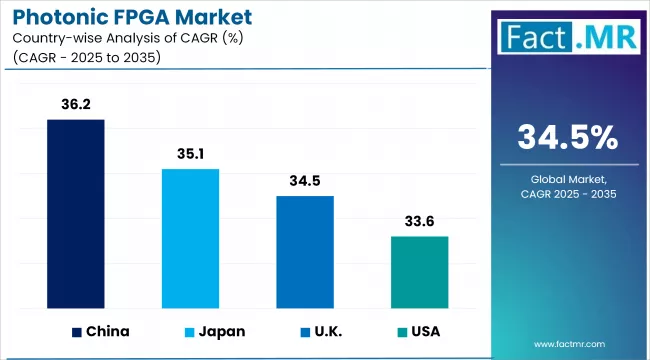
Photonic Fpga Market By Country | Source: Fact.MR
The United States is the Pioneer in Optical Compute Innovation
The United States maintains a strong leadership position in photonic FPGA innovation because of the advantageous semiconductor functional ecosystem and value-added technology alliance. Advances in integrated photonics and AI-optimized hardware platforms have deep funding pipelines in government as well as privately-owned investors.
2025-to-2035.webp "Us Photonic Fpga Market By Country Value(usd Million)2025 To 2035")
Us Photonic Fpga Market By Country Value(usd Million)2025 To 2035 | Source: Fact.MR
The demand generated by hyperscale data centers and cloud providers promotes an attractive market condition to the advanced programmable architectures. Large technology firms are emphasizing optical research internally and are developing partnerships therewithal with start-ups to speed up discoveries in co-packaged photonics and reconfigurable systems.
Exports are not weak, as the U.S. manufacturers focus on exporting its products in the Asia Pacific and European markets concerning the next generation FPGA modules. With the use of IP protections and strategic associations, the United States is ensuring the existence of its dominance in the high-performance photonic computing technologies.
Japan is the Hub for Precision Photonics Engineering
Japan is a leader in the production of precision photonic components using both high technology fabrication facilities and expert material scientists. The nation is highly concentrated on miniaturization and reliability; thus, the country will compete in photonic FPGA substrates and optical interconnects on upcoming AI-driven systems.
Major adopters of photonic-based solutions are domestic electronics and telecommunications giants who have integrated photonic-based networks into the network infrastructure and vehicle electronics. The large investment in research consortia, especially in silicon photonics, strengthens the country in the field of innovation leadership in reconfigurable optical architectures.
The export-led model of Japan is engaged in offering niche and high-performance photonic modules to overseas technology players. Due to this focus on high-quality optical equipment and government support of R&D, continued technological advancement and international reputation are made possible.
The United Kingdom is the Research Capital for Optical Compute
The United Kingdom has emerged as a stronghold for photonic FPGA research, leveraging its academic excellence and innovation-driven technology clusters. Groundbreaking work is being done in reconfigurable photonic architectures due to public-private partnerships, especially in defense and high-speed communication systems.
Strategic levels of the government programs drive domestic adoption as they operate advanced computing technologies as national security and the automation of industries. Such efforts encourage local production and build a healthy ecosystem of the next-generation optical processors.
The U.K. is also in a position to export high-end design IP and specialized optical modules to the North American and Asia market. It is a center of knowledge, and such a position, along with direct funding to the R&D, confirms its role in determining the future of photonics' programmability.
Category-Wise Analysis
All Photonic FPGA Delivers Ultra-High Bandwidth Advantage
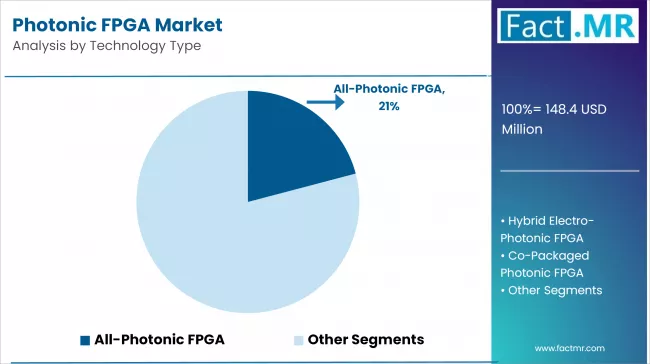
Photonic Fpga Market By Technology Type | Source: Fact.MR
All photonic FPGA architectures are predominant owing to the unsurpassable bandwidth and ultra-low latency advantages of these FPGA architectures when used in data-intensive workloads. These architectures circumnavigate electronic bottlenecks, allowing AI, HPC and cloud environments to work in real-time.
The rate of future adoption will increase as hyperscale networks have to consider sustainable deployment with a greater energy efficiency provider. The current material innovations and design strategies that can be prototyped at scale denounce this segment as the bedrock in the optical compute development.
Data Centers and Cloud Computing Drive Scalable Photonic Integration
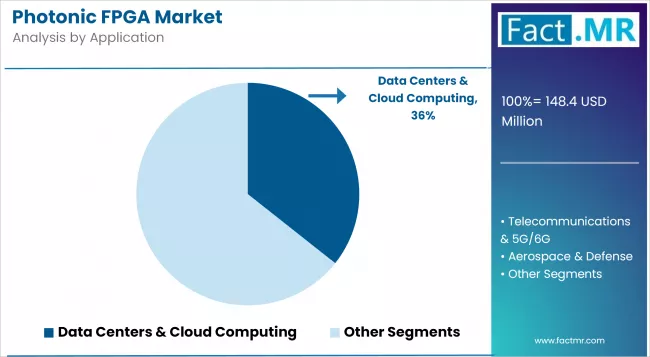
Photonic Fpga Market By Application | Source: Fact.MR
The biggest use of the photonic FPGAs deals with data centers due to the increasing need of high-speed data transfer and optimization of workload. The hyperscale environments are presented with massive throughput that is delivered with these programmable systems.
Future growth ties in with AI workloads, video stream growth and digital transformation in the enterprise. With energy minimization and cost efficiency in mind, photonic FPGAs will continue to be part of cloud infrastructure approaches around the world.
Competitive Analysis
Key players in the photonic FPGA industry include iPronics, Ayar Labs, Lightmatter, Intel, Luxtera (Cisco), Inphi (Marvell), Infinera, QuiX Quantum, NTT Photonics Laboratories, Rockley Photonics, POET Technologies, Alphawave Semi, Elenion Technologies, OpenLight (Synopsys), Effect Photonics, and Xanadu.
The photonic FPGA marketplace is highly competitive based on innovation-led regulations and with players differentiating through integration depth, material expertise, and packaging efficiency. Emerging vendors focus on hybrid architectures to balance scalability and cost optimization.
Procurement decisions prioritize interoperability, low latency, and energy savings. The level of competition is increasing in co-packaged optics and AI acceleration, characterized by fast product cycles and ecosystem collaborations.
Recent Development
- In April 2025, Ayar Labs announced the industry’s first UCIe optical chiplet designed for AI scale-up architectures, enabling chiplet form factor optical I/O and delivering up to 8 Tbps of aggregate bandwidth when paired with its SuperNova light source. The launch emphasizes UCIe compatibility to simplify ecosystem adoption for multi-chip packages and targets hyperscale AI interconnect bottlenecks.
- In December 2024, Lightmatter joined the UALink Consortium as a contributor to help standardize ultra-high-speed, low-latency interconnects for scale-up AI clusters, positioning its Passage 3D-stacked photonic engine within a multi-vendor specification effort.
Fact.MR has provided detailed information about the price points of key manufacturers of the Photonic FPGA Market positioned across regions, sales growth, production capacity, and speculative technological expansion, in the recently published report.
Methodology and Industry Tracking Approach
The 2025 photonic FPGA market report by Fact MR incorporates insights from 1,150 stakeholders across 11 countries, with at least 70 respondents per country. Of these, 62 percent were end users, including data center operators, telecommunications providers, aerospace integrators, and AI infrastructure firms, while 38 percent represented procurement leads, semiconductor R&D executives, and photonic design consultants.
Data collection occurred between May 2024 and June 2025, focusing on critical parameters such as bandwidth performance, energy efficiency, material scalability, packaging innovations, regulatory compliance, and interoperability with AI workloads. A regionally calibrated model ensured accurate representation across North America, Asia Pacific, and Europe.
The study draws from more than 98 validated sources, including optical integration research papers, semiconductor investment reports, industry association publications, technical specifications, and annual filings from leading component manufacturers. All inputs were rigorously triangulated to provide precise estimates and actionable insights for stakeholders across the photonics value chain.
Fact.MR applied rigorous analytical tools such as multi-variable regression and scenario modeling to ensure data robustness. With continuous monitoring of the glass adhesives space since 2018, this report offers a comprehensive roadmap for firms seeking competitive advantage, innovation, and sustainable growth within the sector.
Segmentation of Photonic FPGA Market
-
By Technology Type :
- All-Photonic FPGA
- Hybrid Electro-Photonic FPGA
- Co-Packaged Photonic FPGA
- Programmable Photonic Tile / Array
-
By Reconfiguration Method :
- Thermally Tuned
- Electrically Tuned
- Optically Tuned
-
By Fabrication Material :
- Silicon Photonics
- Silicon Nitride
- Indium Phosphide & III-V Materials
- Lithium Niobate
-
By Application :
- Data Centers & Cloud Computing
- Telecommunications & 5G/6G
- Aerospace & Defense
- High-Performance Computing & AI
- Automotive
- Medical Imaging & Biophotonics
-
By Region :
- North America
- Latin America
- Western Europe
- Eastern Europe
- East Asia
- South Asia & Pacific
- Middle East & Africa