
Metallocene LDPE Market Size, Market Forecast and Outlook By Fact.MR
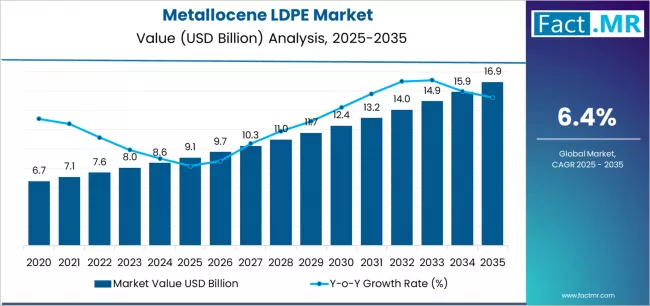
The metallocene LDPE market was valued at USD 9.10 billion in 2025, projected to reach USD 9.68 billion in 2026, and is forecast to expand to USD 18.01 billion by 2036 at a 6.4% CAGR. Flexible packaging converters executing downgauging programs to reduce material consumption per unit area are driving specification shifts from conventional LDPE and LLDPE grades to metallocene-catalyzed resins that deliver equivalent mechanical performance at reduced film thickness. Brand owners mandating recyclability compliance for retail packaging now require mono-material polyethylene film structures that only metallocene LDPE grades can achieve at the required dart impact and seal strength thresholds.
Summary of Metallocene LDPE Market
- Market Overview
- The metallocene LDPE market is valued at USD 9.10 billion in 2025 and is projected to reach USD 18.01 billion by 2036.
- The industry is expected to grow at a 6.4% CAGR from 2026 to 2036, creating an incremental opportunity of USD 8.33 billion.
- The market is a performance-driven polyolefin category where film downgauging economics, mono-material recyclability mandates, and metallocene reactor capacity availability define competitive positioning.
- Demand and Growth Drivers
- Demand is accelerating as flexible packaging converters execute downgauging programs that require metallocene-catalyzed resins to maintain mechanical performance at reduced film thickness.
- Brand owners mandating mono-material polyethylene recyclable packaging structures are driving specification shifts from multi-material laminates to metallocene LDPE-based films.
- E-commerce fulfillment packaging growth in Asia and extended shelf-life food packaging requirements are expanding metallocene sealant layer consumption volumes.
- Among key countries, India leads at 8.5% CAGR, followed by China at 7.8%, South Korea at 6.2%, the USA at 5.6%, Germany at 5.2%, the UK at 5.0%, and Japan at 4.8%.
- Product and Segment View
- Metallocene LDPE resins are polyethylene grades produced using single-site metallocene catalysts that deliver narrow molecular weight distribution, superior optical clarity, and enhanced seal strength compared to conventional Ziegler-Natta catalyzed grades.
- Primary applications span flexible packaging films, sheets, extrusion coatings, injection molding, blow molding, and wire and cable insulation.
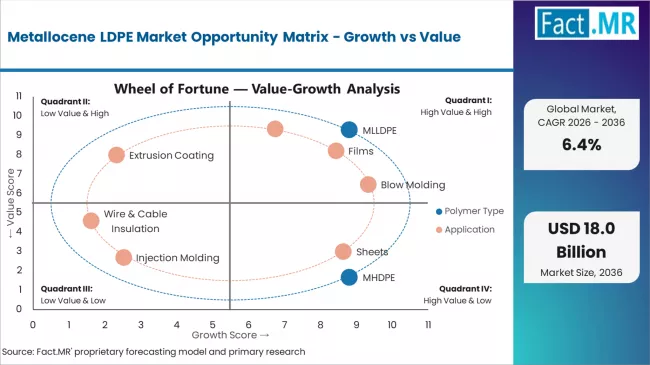
- MLLDPE leads by Polymer Type with 62.7% share in 2026.
- Films lead by Application with 55.7% share in 2026.
- Scope includes metallocene-catalyzed LLDPE and HDPE resins, excluding conventional Ziegler-Natta catalyzed polyethylene, polyethylene waxes, and post-consumer recycled polyethylene grades.
- Geography and Competitive Outlook
- India and China are the fastest-growing markets due to rapidly expanding food packaging and e-commerce fulfillment film demand, while the USA and Germany represent mature conversion-driven markets shaped by recyclability mandates and packaging regulation compliance.
- Competition is shaped by metallocene reactor technology, world-scale production capacity, and exclusive resin supply agreements with major flexible packaging converters.
- Key companies include ExxonMobil, Dow Chemical, SABIC, LyondellBasell, Chevron Phillips Chemical, Borealis, TotalEnergies, INEOS, LG Chem, and Dow-Mitsui Polychemicals.
- Analyst Opinion at Fact.MR
- Shambhu Nath Jha , Principal Consultant for Chemicals and Materials, opines: 'In my analysis, I have observed that the true conversion driver for metallocene LDPE is not resin price competitiveness but the mechanical performance gap that prevents conventional LLDPE from meeting downgauged film specifications at the dart impact thresholds required by automated packaging lines. Converters attempting to maintain production speeds on high-speed form-fill-seal equipment using conventional resins at reduced gauges experience unacceptable puncture failure rates. Brand owners mandating mono-material polyethylene structures for recyclability compliance find that only metallocene grades deliver the sealant layer performance required to replace multi-material laminate barriers. Resin procurement teams delaying metallocene qualification risk losing converter accounts to competitors already running certified metallocene-based film structures.'
- Strategic Implications / Executive Takeaways
- Resin producers must commission metallocene reactor capacity expansions aligned with converter downgauging program timelines to avoid supply allocation constraints during peak packaging season.
- Flexible packaging converters should establish dual-source metallocene resin qualification programs to maintain production flexibility across multiple supplier platforms.
- Brand owners must update packaging material specifications to mandate metallocene-grade polyethylene for mono-material recyclable structures to meet Extended Producer Responsibility compliance deadlines.
Metallocene LDPE Market Key Takeaways
| Metric | Details |
|---|---|
| Industry Size (2026) | USD 9.68 billion |
| Industry Value (2036) | USD 18.01 billion |
| CAGR (2026 to 2036) | 6.4% |
The absolute dollar opportunity of USD 8.33 billion between 2026 and 2036 reflects an accelerating substitution of conventional Ziegler-Natta catalyzed polyethylene grades with metallocene alternatives across high-performance film applications. Resin producers commissioning new metallocene reactor capacity face capital investment requirements that concentrate production among companies operating world-scale gas-phase and solution polymerization units. The price premium of metallocene grades over conventional LLDPE narrows as production volumes scale, but performance differentiation in sealant layers and stretch films sustains margin resilience for producers.
All major flexible packaging corridors reflect accelerated metallocene resin adoption patterns. India sets the pace with an 8.5% CAGR as food packaging converters adopt metallocene sealant layers to meet extended shelf-life specifications. South Korea follows at 6.2% with semiconductor-grade stretch wrap and clean-room packaging film requirements. China advances at 7.8%, supported by rapid e-commerce fulfillment packaging volume growth. United States operations progress at 5.6% through brand-owner mandated mono-material recyclable packaging conversions. Germany registers a 5.2% pace anchored by the Packaging Act requirements for design-for-recycling compliance. United Kingdom expands at 5.0% through Extended Producer Responsibility scheme packaging material targets. Japan tracks at 4.8% through food safety specification tightening for direct-contact packaging films.
Why is the Metallocene LDPE Market Growing?
Market expansion is being supported by the exponential increase in flexible packaging demand and the corresponding need for high-performance polymer solutions in packaging applications across global manufacturing operations. Packaging companies are increasingly focused on metallocene LDPE that can improve film properties, enhance mechanical performance, and optimize processing protocols while meeting stringent food contact requirements.
The proven efficacy of metallocene polyethylene in various packaging applications makes it an essential component of comprehensive flexible packaging strategies and advanced material programs. The growing emphasis on downgauging and material efficiency integration is driving demand for metallocene LDPE products that meet stringent performance specifications and operational requirements for packaging applications.
Flexible packaging manufacturers' preference for reliable, high-performance polymers that can ensure consistent film quality is creating opportunities for innovative catalyst technologies and customized metallocene LDPE solutions. The rising influence of sustainability regulations and packaging waste reduction mandates is also contributing to increased adoption of efficient metallocene LDPE grades across different packaging categories and manufacturing systems requiring advanced polymer materials.
Opportunity Pathways - Metallocene LDPE Market
The metallocene LDPE market represents a transformative growth opportunity, expanding from USD 9.1 billion in 2025 to USD 16.9 billion by 2035 at a 6.4% CAGR. As packaging manufacturers prioritize material efficiency, film property optimization, and sustainability compliance in complex packaging environments, metallocene LDPE has evolved from a specialty polymer to an essential packaging material enabling precise film thickness control, comprehensive mechanical property strategies, and multi-layer functionality operations across flexible packaging platforms and specialty film applications.
The convergence of packaging efficiency acceleration, increasing high-performance polymer penetration, advanced catalyst technology integration, and stringent sustainability mandates creates momentum in demand. High-performance mLLDPE offering superior film properties, cost-effective film grades balancing performance with economics, and specialty resins for advanced applications will capture market premiums, while geographic expansion into high-growth Asian packaging markets and emerging flexible packaging ecosystems will drive volume leadership. Packaging manufacturer emphasis on downgauging capability and optical clarity provides structural support.
- Pathway A - mLLDPE Polymer Type Dominance: Leading with 62.7% market share, mLLDPE applications drive primary demand through diverse film manufacturing workflows requiring comprehensive stretch film solutions for packaging development. Advanced catalyst protocols enabling improved tensile strength, enhanced puncture resistance, and superior optical properties command premium positioning from packaging manufacturers requiring stringent performance specifications and processing reliability. Expected revenue pool: USD 5.7-10.6 billion.
- Pathway B - Films Application Leadership: Dominating with 55.7% market share through optimal balance of packaging necessity and material versatility requirements, film applications serve primary metallocene LDPE consumption requirements while meeting diverse packaging demands. This application addresses both stretch film production and shrink film manufacturing needs, making it the preferred category for packaging converters and flexible packaging operations seeking comprehensive polymer capabilities. Opportunity: USD 5.1-9.4 billion.
- Pathway C - Asian Market Acceleration: India (7.4% CAGR) and China (6.6% CAGR) lead regional growth through packaging industry expansion, consumer goods infrastructure development, and metallocene polymer capability advancement. Strategic partnerships with local film manufacturers, polymer localization expertise, and distribution network optimization enable the expansion of metallocene LDPE across major packaging production and consumer goods hubs. Geographic expansion upside: USD 2.2-4.2 billion.
- Pathway D - Sheets Application Segment: Sheets applications with 14.4% market share serve critical thermoforming and rigid packaging requirements for diverse industrial products. Optimized metallocene formulations supporting multiple forming processes, clarity requirements, and proven stiffness effectiveness maintain significant volumes from thermoforming manufacturers and packaging facilities. Revenue potential: USD 1.3-2.4 billion.
- Pathway E - Advanced Catalyst Technologies & Processing Systems: Companies investing in single-site catalyst innovations, molecular weight distribution control, and advanced film processing systems gain competitive advantages through consistent quality delivery and property optimization. Advanced capabilities enabling customized polymer specifications and rapid grade development capture premium packaging partnerships. Technology premium: USD 1.1-2.0 billion.
- Pathway F - Supply Chain Optimization & Technical Service Excellence: Dedicated technical support programs, strategic converter partnership integration, and reliable application development systems create competitive differentiation in packaging markets requiring consistent metallocene LDPE availability. Companies offering guaranteed processing support, film optimization assistance, and application expertise gain preferred supplier status with quality-focused packaging manufacturers. Supply chain value: USD 0.9-1.7 billion.
- Pathway G - Emerging Applications & Market Development: Beyond traditional film applications, metallocene LDPE in medical packaging, agricultural films, and specialized industrial applications represent growth opportunities. Companies developing new polymer grades, supporting innovation initiatives, and expanding into adjacent specialty packaging and functional film markets capture incremental demand while diversifying revenue streams. Emerging opportunity: USD 0.7-1.3 billion.
Segmental Analysis
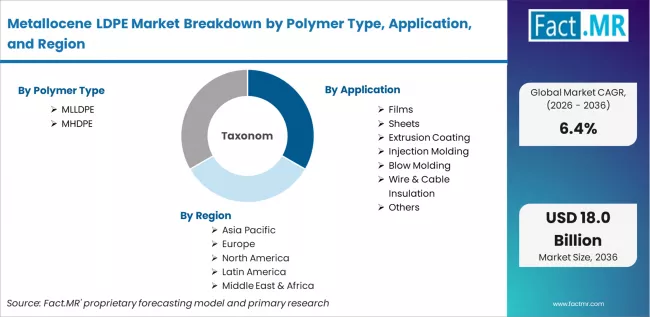
The market is segmented by polymer type, application, and region. By polymer type, the market is divided into mLLDPE and mHDPE. Based on application, the market is categorized into films, sheets, extrusion coating, injection molding, blow molding, wire & cable insulation, and others. Regionally, the market is divided into North America, Asia Pacific, Europe, Latin America, and Middle East & Africa.
Why does mLLDPE Polymer Type Command Market Dominance?

The mLLDPE polymer type segment is projected to account for 62.7% of the metallocene LDPE market in 2025, reaffirming its position as the category's dominant polymer specification. Film manufacturers increasingly recognize the optimal balance of mechanical properties and processing versatility offered by metallocene linear low-density polyethylene for flexible packaging applications, particularly in stretch film and shrink film production.
This polymer category addresses both film strength requirements and optical clarity demands while providing reliable processing outcomes across diverse packaging operations. This segment forms the foundation of most flexible packaging protocols for food packaging development and industrial wrapping production, as it represents the most mechanically versatile and commercially established polymer type in the metallocene polyethylene industry.
Performance validation standards and extensive film testing continue to strengthen confidence in mLLDPE among packaging engineers and film manufacturing professionals. With increasing recognition of downgauging impact on material efficiency and cost reduction requirements, metallocene LLDPE aligns with both current packaging production practices and sustainability evolution goals, making it the central growth driver of comprehensive flexible packaging strategies across multiple application platforms.
How do Film Applications Maintain Primary Market Leadership?

Films are projected to represent 55.7% of metallocene LDPE demand in 2025, underscoring its role as the primary consumption category driving market adoption and packaging technology deployment. Packaging manufacturers recognize that film requirements, including diverse packaging formats, varied thickness specifications, and comprehensive mechanical needs, provide the largest addressable market for metallocene LDPE consumption.
Metallocene LDPE utilized in film production offers enhanced clarity and superior mechanical properties essential for serving stretch wrap applications, food packaging films, and industrial packaging solutions. The segment is supported by the expanding nature of global flexible packaging industry development, requiring materials capable of addressing pallet wrapping, food preservation, and consumer goods packaging, and the increasing recognition that metallocene-based films can improve packaging efficiency and product protection.
Manufacturers are increasingly adopting downgauging approaches that mandate high-performance polymer integration for optimal film strength and material savings. As understanding of metallocene technology capabilities advances and packaging efficiency becomes more valued, metallocene LDPE-enabled film applications will continue to play a crucial role in comprehensive packaging material differentiation strategies.
What are the Drivers, Restraints, and Key Trends of the Metallocene LDPE Market?
The metallocene LDPE market is advancing rapidly due to increasing recognition of packaging efficiency importance and growing demand for high-performance polymer solutions across the packaging sector.
The market faces challenges, including production cost premiums compared to conventional polyethylene in price-sensitive markets, limited processing equipment compatibility in smaller converters, and concerns about catalyst system complexity in certain production facilities. Innovation in catalyst technologies and advanced film processing methodologies continues to influence product development and market expansion patterns.
Proliferation of Advanced Catalyst Technologies and Polymerization Systems
The accelerating adoption of sophisticated catalyst platforms is enabling the development of more precise molecular architectures and enhanced polymer properties that can meet stringent packaging performance and processing requirements.
Film manufacturers demand comprehensive property integration for metallocene LDPE, including narrow molecular weight distribution capabilities and optimized comonomer incorporation formulations that are particularly important for achieving superior mechanical properties in complex packaging applications.
Advanced catalyst technologies provide access to enhanced polymer characteristics that can optimize film performance and improve processing efficiency while maintaining cost-effectiveness for diverse packaging production environments.
Integration of Sustainability Platforms and Circular Economy Capabilities
Modern packaging organizations are incorporating advanced technologies such as recyclability enhancement systems, bio-based feedstock compatibility, and circular design interfaces to enhance metallocene LDPE environmental performance and market positioning.
These systems improve resource efficiency opportunities, enable seamless conventional-to-sustainable packaging transitions, and provide better integration between polymer suppliers and brand owners throughout the packaging lifecycle experience.
Advanced sustainability capabilities also enable customized environmental protocols and early identification of recyclability concerns or processing compatibility issues, supporting proactive sustainability management and improved environmental outcomes.
Analysis of the Metallocene LDPE Market by Key Countries
.webp "Top Country Growth Comparison Metallocene Ldpe Market Cagr (2026 2036)")
| Country | CAGR (2026-2036) |
|---|---|
| India | 7.4% |
| USA | 6.8% |
| China | 6.6% |
| Saudi Arabia | 6.1% |
| Germany | 5.9% |
| Brazil | 5.4% |
| Japan | 4.8% |
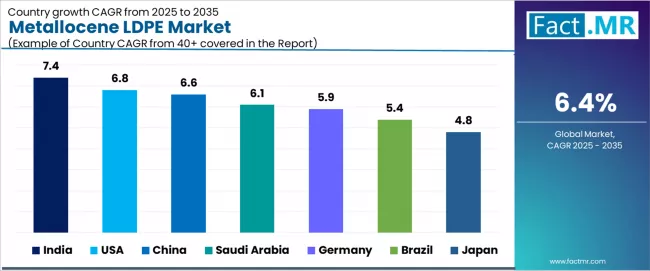
The metallocene LDPE market is experiencing exceptional growth globally, with India leading at a 7.4% CAGR through 2036, driven by expanding packaging industry capacity, growing flexible packaging adoption, and increasing polymer processing infrastructure development across major manufacturing and consumer centers.
The USA follows at 6.8%, supported by advanced packaging technology leadership, e-commerce packaging expansion, and comprehensive flexible packaging modernization initiatives. China records 6.6% growth, benefiting from massive consumer goods packaging sector and expanding metallocene production capacity.
Saudi Arabia demonstrates 6.1% growth, emphasizing petrochemical integration and regional packaging market expansion. Germany shows 5.9% growth with high-performance packaging leadership and sustainable material development focus. Brazil records 5.4% growth, representing food packaging expansion and flexible packaging modernization, while Japan shows 4.8% growth, representing advanced film technology and mature packaging industry optimization.
How does India Demonstrate Exceptional Market Potential with Expanding Packaging Capacity?
The metallocene LDPE market in India is projected to exhibit exceptional growth with a CAGR of 7.4% through 2036, driven by rapidly expanding packaging industry capacity and increasing recognition of high-performance polymers as an essential component for flexible packaging development and food safety enhancement. The country's growing consumer goods sector and improving availability of advanced polymer processing infrastructure are creating significant opportunities for metallocene LDPE deployment across both food packaging and emerging industrial film segments.
Major international polymer suppliers and domestic converters are establishing comprehensive processing facilities to serve the expanding population of packaging manufacturers and flexible film producers requiring metallocene polymers across food packaging operations, stretch film production, and industrial wrapping applications throughout India's diverse manufacturing and metropolitan regions.
The Indian government's strategic emphasis on food safety improvement and packaging industry development is driving substantial investments in polymer processing capabilities and flexible packaging infrastructure availability. This policy support, combined with the country's enormous consumer market and growing organized retail penetration, creates a favorable environment for metallocene LDPE market development. Indian packaging manufacturers are increasingly focusing on high-performance film production to improve product protection, with metallocene polymers representing a key component in this quality enhancement capability building.
- Government initiatives supporting food safety standards and packaging modernization are driving demand for advanced polymers across food and consumer goods segments
- Manufacturing capacity expansion and film technology advancement are supporting appropriate utilization of metallocene LDPE among converters and packaging facilities nationwide
- Manufacturers and brand owners are increasingly recognizing film property importance in product protection, creating new polymer demand capabilities
- Rising packaging industry investment and growing awareness of downgauging benefits are accelerating metallocene LDPE adoption across application categories
What makes the USA Demonstrate Market Leadership with Advanced Packaging Technology?
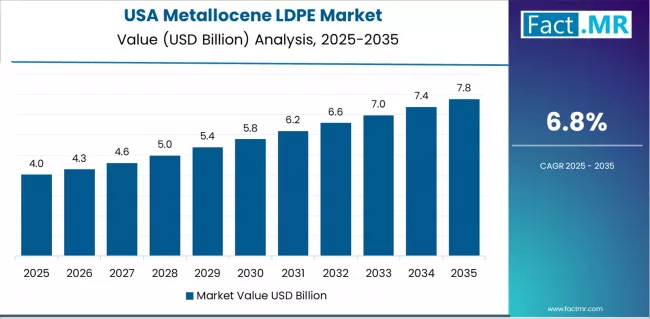
The metallocene LDPE market in the USA is expanding at a CAGR of 6.8%, supported by advanced packaging technology leadership, rapidly expanding e-commerce packaging demand, and comprehensive flexible packaging infrastructure across the country's developed industrial and consumer corridors. The country's sophisticated packaging manufacturing capabilities and increasing adoption of high-performance polymer platforms are driving demand for metallocene LDPE solutions in both traditional and emerging applications.
International polymer producers and domestic converters are expanding production capacity to serve the growing demand for quality metallocene LDPE while supporting the country's position as a leading packaging innovation and flexible film market. USA's packaging sector continues to benefit from technological innovation leadership, advanced processing infrastructure, and strong consumer brand commitment to packaging quality.
The country's focus on expanding sustainable packaging capabilities is driving investments in advanced polymer technologies including metallocene catalyst systems and recyclability enhancement. This development is particularly important for metallocene LDPE applications, as manufacturers seek high-performance materials for packaging optimization to enhance product protection and meet growing e-commerce packaging demands while maintaining sustainability commitments.
- Advanced packaging technology and e-commerce growth driving opportunities for high-performance metallocene LDPE solutions
- Growing sustainability focus and flexible packaging modernization supporting increased deployment of metallocene polymers across packaging categories
- Expanding processing capabilities and quality standards driving innovative applications of metallocene LDPE in packaging and industrial applications
- Packaging technology advancement enabling delivery of sophisticated film products, supporting market growth and enhancing material efficiency
Why does China Maintain Consumer Goods Packaging Growth?
The metallocene LDPE market in China is projected to exhibit strong growth with a CAGR of 6.6% through 2036, driven by massive consumer goods packaging operations and expanding metallocene production sector. The country's position as a leading packaging manufacturer and growing high-performance polymer capacity are creating significant opportunities for metallocene LDPE integration across both domestic and export packaging applications. Chinese packaging producers are leveraging manufacturing scale to serve growing demand for metallocene polymers while supporting the country's position as a major packaging materials economy.
The market benefits from integrated petrochemical infrastructure supporting polymer production, enabling optimized metallocene LDPE manufacturing and comprehensive flexible packaging integration. This development is particularly important for metallocene LDPE applications, as manufacturers seek cost-effective high-performance materials that maximize packaging efficiency while ensuring quality consistency in commercial packaging production and consumer goods manufacturing environments.
Strategic Market Considerations:
- Consumer goods packaging and e-commerce segments leading growth with focus on film performance and material efficiency applications
- Manufacturing scale and growing quality expectations driving diverse metallocene LDPE portfolios from standard film grades to specialty high-performance platforms
- Polymer production capabilities and packaging expertise supporting competitive positioning in Asian packaging markets
- Quality requirements and performance standards influencing polymer specifications and advanced metallocene adoption timelines
How does Saudi Arabia Maintain Petrochemical Integration Leadership?
Saudi Arabia's expanding metallocene LDPE market demonstrates accelerating polymer adoption with a CAGR of 6.1% through 2036, driven by petrochemical integration advantages, regional packaging market expansion, and developing polymer processing across major industrial regions.
The country's position as a petrochemical producer and growing focus on downstream value addition are creating opportunities for metallocene LDPE integration across both regional and export packaging applications. Saudi petrochemical operators are leveraging feedstock advantages to serve growing demand for metallocene polymers while supporting the country's position as a polymer materials economy.
Market dynamics focus on cost-competitive metallocene products that balance performance characteristics with production efficiency important to regional packaging markets. Growing domestic polymer production expertise creates opportunities for integrated manufacturing programs and metallocene LDPE supply deployment.
Strategic Market Considerations:
- Petrochemical integration and regional packaging segments demonstrating focused growth with emphasis on cost competitiveness and export market applications
- Feedstock advantages and growing downstream capabilities driving diverse metallocene LDPE portfolios from commodity film grades to specialty polymer platforms
- Petrochemical expertise and production scale supporting competitive positioning in Middle East and global packaging markets
- Industry development and value-addition initiatives beginning to influence production specifications and advanced polymer adoption timelines
What drives Germany’s Market Growth with High-Performance Packaging Excellence?
Germany's advanced packaging market demonstrates sophisticated metallocene LDPE deployment with documented effectiveness in high-performance film platforms and sustainable packaging applications through integration with cutting-edge processing technologies and quality protocols.
The country leverages packaging technology leadership and comprehensive environmental compliance infrastructure to maintain a 5.9% CAGR through 2036. Packaging manufacturers, including major flexible film converters in industrial regions and specialty packaging companies, showcase advanced metallocene LDPE implementations where high-performance polymers integrate with comprehensive sustainability platforms and ongoing material optimization to ensure film quality and environmental compliance.
German packaging manufacturers prioritize material efficiency and sustainability in production development, creating demand for premium metallocene LDPE with advanced characteristics, including superior mechanical properties and integration with comprehensive recycling systems. The market benefits from established high-performance packaging infrastructure and commitment to sustainable materials that provide superior environmental outcomes and compliance with stringent European standards and brand commitments.
Strategic Market Considerations:
- High-performance packaging and sustainable film segments leading growth with focus on material efficiency and environmental compliance applications
- Stringent sustainability expectations driving sophisticated metallocene LDPE portfolios from conventional film grades to advanced recyclable platforms
- Packaging technology excellence and sustainability leadership supporting continued advancement in metallocene LDPE application development
- Environmental standards and circular economy requirements ensuring consistent material quality and sustainability outcome optimization
How does Brazil Maintain Food Packaging Growth?
Brazil's expanding metallocene LDPE market demonstrates accelerating high-performance polymer adoption with a CAGR of 5.4% through 2036, driven by food packaging expansion, flexible packaging modernization, and developing polymer processing across major industrial regions.
The country's position as a food production economy and growing consumer goods packaging sector are creating opportunities for metallocene LDPE integration across both food contact and industrial applications. Brazilian packaging manufacturers are developing polymer processing capabilities to serve growing demand for metallocene LDPE while supporting the country's position as a regional packaging materials market.
Market dynamics focus on reliable metallocene products that balance performance characteristics with cost considerations important to food packaging and consumer goods sectors. Growing domestic processing expertise creates opportunities for integrated packaging programs and metallocene LDPE deployment.
Strategic Market Considerations:
- Food packaging and consumer goods segments demonstrating focused growth with emphasis on film quality and food safety applications
- Industry development and growing quality awareness driving diverse metallocene LDPE portfolios from standard packaging grades to specialty food contact platforms
- Processing capabilities and food industry expertise supporting competitive positioning in Latin American packaging markets
- Food safety requirements and quality standards beginning to influence polymer specifications and high-performance material adoption timelines
What Drives Japan Market Growth with Advanced Film Technology?

Japan's advanced packaging market demonstrates sophisticated metallocene LDPE deployment with documented effectiveness in specialty film platforms and precision packaging applications through integration with cutting-edge processing systems and quality control. The country leverages film technology excellence and precision manufacturing methodology to maintain a 4.8% CAGR through 2036.
Film manufacturing facilities, including major packaging operations in industrial centers, showcase advanced metallocene LDPE implementations where high-quality polymers integrate with comprehensive processing programs and ongoing technology optimization to ensure film consistency and performance reliability.
Japanese manufacturers prioritize film quality and long-term packaging excellence in material selection, creating demand for premium metallocene LDPE with advanced features, including ultra-consistent properties and integration with Japanese quality standards. The market benefits from established advanced film infrastructure and commitment to manufacturing excellence that drives continuous material advancement.
Strategic Market Considerations:
- Specialty films and precision packaging segments leading growth with focus on quality control and comprehensive property applications
- Stringent quality requirements driving sophisticated metallocene LDPE portfolios from conventional polymers to specialty ultra-consistent platforms
- Film manufacturing excellence and technology leadership supporting competitive positioning in Asian advanced materials markets
- Professional standards and industry collaboration emphasizing precision processing approaches and continuous quality improvement
Europe Market Split by Country
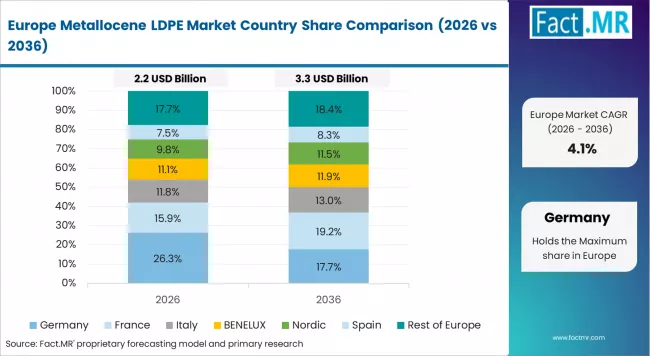
The metallocene LDPE market in Europe is projected to grow from USD 2.2 billion in 2026 to USD 3.8 billion by 2036, registering a CAGR of 5.6% over the forecast period. Germany is expected to maintain its leadership position with a 38.2% market share in 2026, rising to 39.6% by 2036, supported by its dominant flexible packaging infrastructure, comprehensive polymer processing capabilities, and advanced high-performance film expertise throughout major converting facilities and packaging networks.
France follows with a 21.8% share in 2026, projected to reach 22.4% by 2036, driven by food packaging excellence, polymer technology presence, and expanding sustainable packaging sophistication serving both domestic and European markets. The UK holds a 17.3% share in 2026, expected to increase to 17.9% by 2036, supported by comprehensive retail packaging infrastructure and flexible film development. Italy commands a 12.4% share in 2026, projected to reach 11.6% by 2036, while Spain accounts for 7.9% in 2026, expected to reach 7.1% by 2036.
The rest of Europe region, including Nordic countries with advanced sustainability standards, Eastern European emerging packaging markets, and smaller Western European specialty converters, is anticipated to hold 2.4% in 2026, declining slightly to 1.4% by 2036, attributed to market consolidation toward larger core markets with established flexible packaging infrastructure and metallocene processing expertise.
Competitive Landscape of the Metallocene LDPE Market
The metallocene LDPE market is characterized by intense competition among established petrochemical companies, specialty polymer producers, and comprehensive polyethylene manufacturers focused on delivering high-quality, reliable, and consistently specified metallocene solutions.
Companies are investing in catalyst development programs, advanced polymerization technology acquisition, strategic converter partnerships, and comprehensive technical service initiatives to deliver effective, consistent, and performance-optimized metallocene LDPE that meets stringent quality standards and customer expectations. Processing support, property consistency emphasis, and application development strategies are central to strengthening product portfolios and market presence.
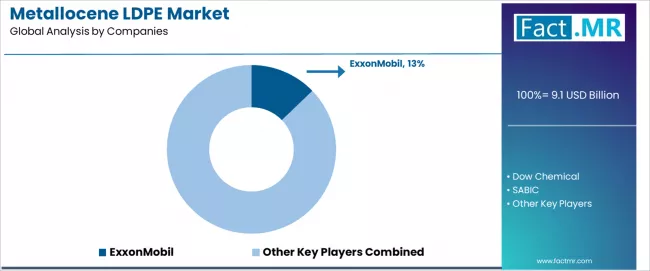
ExxonMobil leads the market with a 12.8% market share, offering comprehensive metallocene LDPE solutions with a focus on catalyst technology expertise and advanced polymerization capabilities for packaging applications. Dow Chemical provides diversified metallocene platforms with emphasis on film applications and comprehensive technical support across flexible packaging markets.
SABIC focuses on integrated petrochemical production and comprehensive metallocene solutions serving international packaging communities. LyondellBasell delivers polymer innovation expertise with strong converter partnerships and processing technology integration.
Chevron Phillips Chemical operates with a focus on metallocene catalyst development and comprehensive film-grade solutions for packaging applications. Borealis provides European market leadership emphasizing sustainability excellence and comprehensive circular economy platforms. TotalEnergies specializes in integrated polymer production with emphasis on flexible packaging applications and comprehensive material solutions.
INEOS delivers competitive polymer offerings to enhance market accessibility and provide reliable metallocene products. LG Chem and Dow-Mitsui Polychemicals focus on Asian market development and regional production capabilities with emphasis on quality consistency and application support through dedicated metallocene polyethylene manufacturing strategies.
Key Players in the Metallocene LDPE Market
- ExxonMobil
- Dow Chemical
- SABIC
- LyondellBasell
- Chevron Phillips Chemical
- Borealis
- TotalEnergies
- INEOS
- LG Chem
- Dow-Mitsui Polychemicals
Bibliography
- European Commission. (2024, December). Packaging and Packaging Waste Regulation (PPWR): Design-for-recycling criteria for plastic packaging. European Commission, DG Environment.
- American Chemistry Council. (2025, February). U.S. resin production and sales: 2024 annual statistics. ACC Plastics Industry Producers.
- Bureau of Indian Standards. (2024). IS 9845:2024 Specification for polyethylene film for food packaging. BIS, Government of India.
- PlasticsEurope. (2025, January). Plastics, the circular economy, and Europe's environment: 2024 annual monitoring report. PlasticsEurope AISBL.
- Ministry of Economy, Trade and Industry, Japan. (2024). Plastic resource circulation strategy: Updated packaging material standards. METI.
This bibliography is provided for reader reference. The full Fact.MR report contains the complete reference list with primary research documentation.
This Report Addresses
- Market sizing and quantitative forecast metrics detailing the precise metallocene polyethylene resin expenditure across major flexible packaging and specialty application sectors through 2036.
- Segmentation analysis mapping the adoption velocity of metallocene LLDPE and HDPE grades and evaluating the performance qualification barriers driving resin supplier consolidation.
- Regional deployment intelligence comparing rapid packaging volume growth in Asian markets against recyclability mandate-driven conversion in North American and European packaging sectors.
- Packaging regulation compliance assessment analyzing how Extended Producer Responsibility schemes and design-for-recycling mandates force mono-material metallocene polyethylene film adoption.
- Competitive posture evaluation tracking metallocene reactor capacity expansion investments and the consolidation of world-scale production among major polyolefin resin companies.
- Capital project strategic guidance defining the exact mechanical performance and optical clarity specifications required for metallocene grades to displace conventional LLDPE in target film applications.
- Supply chain analysis identifying the specific reactor capacity constraints and resin allocation mechanisms that affect metallocene grade availability during peak packaging seasons.
- Custom data delivery formats encompassing interactive dashboards, raw Excel datasets, and comprehensive PDF narrative reports.
Metallocene LDPE Market Definition
Metallocene LDPE refers to low-density polyethylene and linear low-density polyethylene resins produced using single-site metallocene catalyst technology. These resins exhibit narrow molecular weight distribution, superior optical clarity, enhanced dart impact strength, and improved hot-tack seal performance compared to polyethylene grades produced with conventional multi-site Ziegler-Natta catalyst systems. Primary industrial functions include flexible packaging film production, extrusion coating, and specialty molding applications where mechanical performance at reduced material thickness is required.
Metallocene LDPE Market Inclusions
Market scope includes metallocene-catalyzed LLDPE (MLLDPE) and metallocene-catalyzed HDPE (MHDPE) resins sold as pellets for film extrusion, sheet extrusion, extrusion coating, injection molding, blow molding, and wire and cable insulation. The report covers global and regional market sizes, forecast period 2026 to 2036, and segment breakdowns by polymer type and application.
Metallocene LDPE Market Exclusions
The scope excludes conventional Ziegler-Natta catalyzed LLDPE and HDPE resins, polyethylene waxes and processing aids, post-consumer recycled polyethylene grades, and bio-based polyethylene produced from renewable feedstocks.
Metallocene LDPE Market Research Methodology
- Primary Research: Analysts engaged with polyolefin resin sales directors, flexible packaging converter procurement leads, and metallocene reactor technology licensors to map resin qualification cycles and capacity expansion timelines.
- Desk Research: Data collection aggregated polyethylene production capacity announcements, packaging regulation compliance deadlines, and metallocene catalyst patent expiration schedules.
- Market-Sizing and Forecasting: Baseline values derive from a bottom-up aggregation of metallocene resin consumption volumes per million square meters of flexible packaging film converted, applying application-specific resin substitution rates.
- Data Validation and Update Cycle: Projections are tested against publicly reported polyolefin segment revenues from major resin producers and flexible packaging converter material procurement disclosures.
Scope of the Report
| Metric | Value |
|---|---|
| Quantitative Units | USD 9.68 billion to USD 18.01 billion, at a CAGR of 6.4% |
| Market Definition | Metallocene LDPE refers to low-density polyethylene and linear low-density polyethylene resins produced using single-site metallocene catalyst technology. These resins exhibit narrow molecular weight distribution, superior optical clarity, enhanced dart impact strength, and improved hot-tack seal performance compared to polyethylene grades produced with conventional multi-site Ziegler-Natta catalyst systems. Primary industrial functions include flexible packaging film production, extrusion coating, and specialty molding applications where mechanical performance at reduced material thickness is required. |
| Polymer Type Segmentation | MLLDPE, MHDPE |
| Application Segmentation | Films, Sheets, Extrusion Coating, Injection Molding, Blow Molding, Wire & Cable Insulation, Others |
| Regions Covered | North America, Latin America, Europe, East Asia, South Asia, Oceania, Middle East & Africa |
| Countries Covered | India, China, USA, Germany, Japan, South Korea, UK, and 40 plus countries |
| Key Companies Profiled | ExxonMobil, Dow Chemical, SABIC, LyondellBasell, Chevron Phillips Chemical, Borealis, TotalEnergies, INEOS, LG Chem, Dow-Mitsui Polychemicals |
| Forecast Period | 2026 to 2036 |
| Approach | Baseline values derive from a bottom-up aggregation of metallocene resin consumption volumes per million square meters of flexible packaging film converted, applying application-specific resin substitution rates. |
Metallocene LDPE Market by Segments
-
Polymer Type :
- mLLDPE
- mHDPE
-
Application :
- Films
- Sheets
- Extrusion Coating
- Injection Molding
- Blow Molding
- Wire & Cable Insulation
- Others
-
Region :
-
North America
- USA
- Canada
- Mexico
-
Asia Pacific
- China
- India
- Japan
- South Korea
- ASEAN
- Australia & New Zealand
- Rest of Asia Pacific
-
Europe
- Germany
- France
- UK
- Italy
- Spain
- Nordic
- BENELUX
- Rest of Europe
-
Latin America
- Brazil
- Argentina
- Chile
- Rest of Latin America
-
Middle East & Africa
- Kingdom of Saudi Arabia
- Other GCC Countries
- Turkey
- South Africa
- Other African Countries
- Rest of Middle East & Africa
-
- Frequently Asked Questions -
How large is the demand for metallocene LDPE in the global market in 2026?
Demand for metallocene LDPE in the global market is estimated to be valued at USD 9.68 billion in 2026.
What will be the market size of metallocene LDPE in the global market by 2036?
Market size for metallocene LDPE is projected to reach USD 18.01 billion by 2036.
What is the expected demand growth for metallocene LDPE in the global market between 2026 and 2036?
Demand for metallocene LDPE is expected to grow at a CAGR of 6.4% between 2026 and 2036.
Which Polymer Type is poised to lead global sales by 2026?
MLLDPE accounts for 62.7% in 2026 as flexible packaging converters prioritize metallocene linear low-density grades for their superior dart impact and seal strength performance in downgauged film structures.
How significant is the role of Films in driving metallocene LDPE adoption in 2026?
Films represent 55.7% of segment share as packaging converters specify metallocene resins to achieve required mechanical performance at reduced film thickness for food packaging, stretch wrap, and e-commerce mailer applications.
What is the India growth outlook in this report?
India is projected to grow at a CAGR of 8.5% during 2026 to 2036.
What is China's growth outlook in this report?
China is projected to expand at a CAGR of 7.8% during 2026 to 2036.
What is metallocene LDPE and what is it mainly used for?
Metallocene LDPE is polyethylene resin produced using single-site metallocene catalysts that deliver superior mechanical and optical properties compared to conventional grades. It is primarily used in flexible packaging films, extrusion coatings, and specialty molding where performance at reduced material thickness is required.

Author:
S.N. Jha

Editor:
Naved Ahmed