


- Base Value(2025): 184 Bn
- Estimated Value(2026): 194 Bn
- Forecast Value (2036): 328.3 Bn
- CAGR (2026 - 2036): 5.4%
Functional Beverage Market Forecast and Outlook By Fact.MR
In 2025, the functional beverage market was valued at USD 184 billion. Based on Fact.MR analysis, demand for functional beverages is estimated to grow to USD 194 billion in 2026 and USD 328.3 billion by 2036. FACT.MR projects a CAGR of 5.4% during the forecast period.
FACT.MR analysis suggests the functional beverage market will generate an absolute dollar opportunity of USD 134.3 billion between 2026 and 2036. Expansion is driven by consumer health-and-wellness prioritization, sports nutrition adoption in younger demographics, and probiotic drink growth across gut health-aware consumer segments. Structural constraints include EU and UK regulatory tightening on high-caffeine energy drinks, sugar levy pressure on mainstream functional formulations, and private label competition compressing margins in mass-market channels.
Country growth reflects health and wellness trends, sports nutrition adoption, and regulatory frameworks. India leads at 7.5% CAGR, driven by rapid urban middle-class expansion adopting sports, energy, and probiotic drinks through modern retail and e-commerce. China follows at 6.8%, supported by strong demand for health-functional beverages among urban youth and the growing herbal and TCM-infused segment. Germany posts 5.7% as organic and clean-label functional beverages capture premiumisation demand through health stores and online. Brazil grows at 5.3% through expanding fitness culture and rising access to sports and nutraceutical drinks in hypermarkets. The United States and the United Kingdom, the most mature markets, each post 5.0%, sustained by sports nutrition and probiotic adoption, with sugar tax enforcement and high-caffeine regulation limiting faster growth in conventional energy drinks.
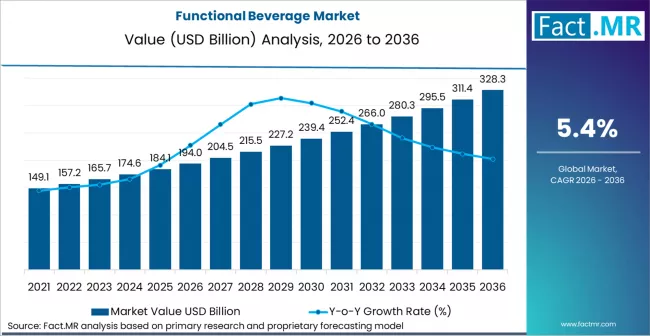
| Metric | Value |
|---|---|
| Estimated Value in 2026 | USD 194 billion |
| Forecast Value in 2036 | USD 328.3 billion |
| Forecast CAGR (2026 to 2036) | 5.4% |
Market Definition
The functional beverage market includes drinks formulated with added bioactive ingredients such as vitamins, minerals, probiotics, amino acids, antioxidants, and botanical extracts. Key categories include energy drinks, sports drinks, probiotic beverages, nutraceutical drinks, fortified juices, and enhanced water.
Market Inclusions
Includes global and regional revenue forecasts from 2026 to 2036 by ingredient type, product type, and distribution channel. Covers major functional beverage categories across supermarkets, hypermarkets, health stores, convenience stores, departmental stores, and online retail channels globally.
Market Exclusions
Excludes conventional carbonated soft drinks, plain bottled water, and dairy beverages without functional ingredients. Also excludes alcoholic beverages, non-beverage meal replacements, pharmaceutical oral rehydration solutions, and clinical nutrition drinks classified as medical foods.
Research Methodology
- Primary Research: Interviews with beverage brand managers, retail category buyers, sports nutrition distributors, regulatory specialists, and health trend analysts.
- Desk Research: Sources include FDA labeling rules, EFSA health claim approvals, EU caffeine regulations, UK sugar levy data, OEM reports, and retail sales databases.
- Market Sizing and Forecasting: Hybrid top-down and bottom-up model using retail sales volumes, average selling prices, ingredient cost trends, and health expenditure projections.
- Data Validation and Update Cycle: Forecasts validated using OEM revenue disclosures, retail sales data, regulatory filings, and consumer health spending surveys.
Summary of Functional Beverage Market
- Market Definition
- Functional beverages are drinks enriched with bioactive ingredients delivering energy, hydration, gut health, or performance benefits.
- Demand Drivers
- Rising health awareness in Asia is increasing demand for probiotic and vitamin-fortified beverages.
- Growing sports nutrition adoption among younger consumers supports demand for protein and amino acid drinks.
- Clean-label trends are shifting demand toward botanical, adaptogen, and nootropic beverages.
- Key Segments Analyzed
- By Ingredient Type: Probiotics hold about 35% share in 2026 due to strong global gut health awareness.
- By Product Type: Energy drinks lead with around 42% share in 2026 due to established brand presence and wide retail distribution.
- By Distribution Channel: Supermarkets and hypermarkets dominate sales, while online retail is the fastest-growing channel.
- Analyst Opinion at FACT.MR
- Shambhu Nath Jha notes that market growth through 2036 will be driven by probiotic and adaptogen beverage premiumisation and strong Asia Pacific demand.
- Strategic Implications
- Brands should reformulate energy drinks to meet EU caffeine limits and UK sugar tax thresholds.
- Companies should expand direct-to-consumer online sales in fast-growing markets such as India and China.
- Manufacturers should launch affordable probiotic beverage lines for mainstream supermarket distribution.
- Methodology
- Market sizing used retail sales volumes and pricing data validated with OEM revenue disclosures.
- Regulatory data from FDA, EFSA, and EU caffeine policies supported compliance analysis.
- Forecasts included consumer health spending data, sports nutrition adoption trends, e-commerce growth, and industry interviews.
Segmental Analysis
Functional Beverage Market Analysis by Ingredient Type
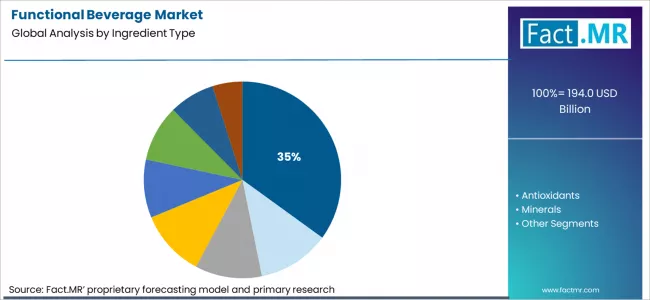
Based on FACT.MR’s report, probiotics are expected to hold about 35% share in 2026. They dominate due to strong consumer awareness of gut health and increasing availability across dairy and plant-based beverage formats.
- Danone Probiotic Platform Investment: In 2025, Danone expanded its Activia probiotic beverage line with added immunity-support ingredients targeting supermarket consumers. [5]
- PepsiCo Prebiotic Technology Development: In 2024, PepsiCo introduced a prebiotic cola with added fibre, combining functional health benefits with traditional soft drink formats. [6]
- Vitamin Fortification Adoption Trend: Vitamin-fortified enhanced water is one of the fastest-growing beverage segments in U.S. supermarkets due to rising demand for hydration with added nutrients. [7]
Functional Beverage Market Analysis by Product Type
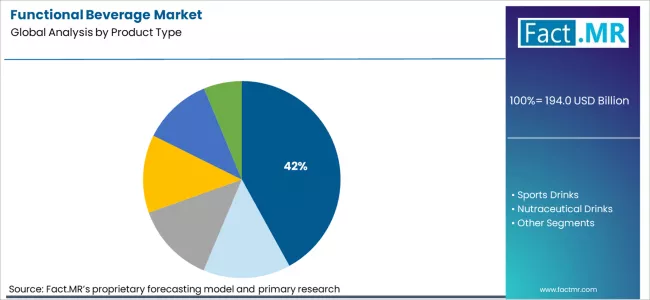
Based on FACT.MR’s report, energy drinks are projected to hold about 42% share in 2026. They lead due to strong brand recognition, frequent consumer purchases, and wide retail distribution.
- Monster Beverage Market Investment: In 2025, Monster expanded distribution across several Asia Pacific markets to capture rising urban youth demand. [8]
- Coca-Cola Sports Drink Technology: In 2024, Coca-Cola launched an enhanced sports hydration drink with added creatine and amino acids targeting fitness consumers. [9]
- Nutraceutical Drink Adoption Trend: Health store sales data shows rapid growth in nutraceutical beverages containing collagen, adaptogens, and botanical extracts. [10]
Drivers, Restraints, and Opportunities
FACT.MR analysts observe that the functional beverage market, valued at USD 184 billion in 2025, has evolved from a niche sports drink segment into a mainstream health-focused beverage category. Growth is supported by rising consumer demand for immunity support, gut health, energy, and cognitive performance benefits.
The market shows a divide between traditional energy drinks and premium functional formats. High-caffeine and sugar-based drinks face regulatory pressure, while probiotic, adaptogen, and low-sugar beverages are growing faster and commanding higher price premiums.
- EU Caffeine and Sugar Regulation Pressure: EU regulators and the UK sugar levy continue restricting high-sugar energy drinks and limiting sales to minors, encouraging reformulation and reduced sugar content across beverage portfolios. [2]
- India Wellness Beverage Growth: Updated FSSAI regulations in 2024 enabled clearer functional beverage labeling, supporting wider distribution of electrolyte and wellness drinks across India’s retail channels. [3]
- Probiotic Beverage Clinical Evidence: Probiotic beverage brands are strengthening clinical evidence supporting gut health benefits, improving regulatory compliance and marketing credibility. [4]
Regional Analysis
The functional beverage market is analysed across Asia Pacific, Europe, North America, Latin America, and Middle East and Africa, covering 40+ countries with demand profiles shaped by health and wellness consumer trends, sports nutrition adoption, regulatory frameworks for health claims and ingredient safety, and distribution channel development. The full report offers market attractiveness analysis based on consumer expenditure growth and regulatory environment timelines.
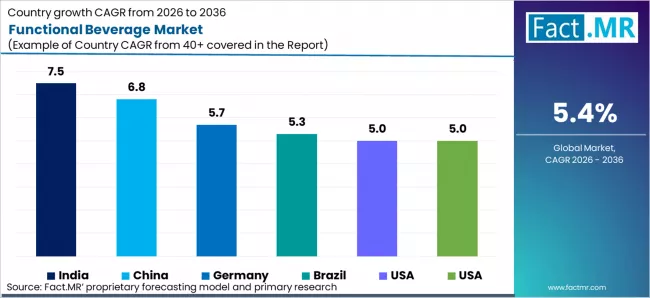
| Country | CAGR (2026-2036) |
|---|---|
| India | 7.5% |
| China | 6.8% |
| Germany | 5.7% |
| Brazil | 5.3% |
| United States | 5.0% |
| United Kingdom | 5.0% |
Source: Fact.MR (FACT.MR) analysis, based on proprietary forecasting model and primary research
Asia Pacific Functional Beverage Market Analysis
Asia Pacific is the fastest-growing region for functional beverages, driven by India’s expanding urban consumer base and China’s strong health-oriented beverage innovation ecosystem. The Coca-Cola Company, PepsiCo, and Monster Beverage lead premium and energy drink distribution, while local champions including Yakult, Pocari Sweat, and Nongfu Spring hold strong positions in probiotic and functional hydration categories.
- India: Functional beverage demand in India is set to expand at a 7.5% CAGR through 2036. The Food Safety and Standards Authority of India (FSSAI) updated its Functional Foods and Nutraceuticals Regulations in 2024. The update created clearer approval pathways for health claims on functional beverages. This enabled launches such as Coca-Cola India’s Minute Maid Vitingo fortified juice and PepsiCo India’s Quaker oat-based functional drink in early 2025.
- China: Demand for functional beverages in China is projected to grow at 6.8% CAGR through 2036. China’s State Administration for Market Regulation updated functional beverage labelling standards in 2024. The new rules require stronger scientific evidence for health benefit claims. This prompted reformulation effort by brands such as Nongfu Spring’s Tea Pi probiotic tea and Red Bull China’s herbal energy drinks.
FACT.MR’s Asia Pacific analysis of the functional beverage market covers China, Japan, South Korea, India, Australia and New Zealand, ASEAN, and Rest of South Asia and Pacific. Readers can find country CAGR forecasts, regulatory labelling update timelines, e-commerce functional beverage trend data, and brand penetration benchmarks by product type.
Europe Functional Beverage Market Analysis
Europe is a mature, regulation-shaped functional beverage market where EFSA health claim frameworks and EU sugar and caffeine restrictions are driving product reformulation and premiumisation. Coca-Cola, PepsiCo, and Red Bull dominate mainstream channel volume, while Danone and GlaxoSmithKline lead science-backed functional beverage categories with established EFSA-approved health claim positions.
Germany: Germany’s functional beverage market is likely to record a 5.7% CAGR through 2036. The German Federal Ministry of Food and Agriculture updated functional beverage labelling rules in 2024. The update requires clearer front-of-pack caffeine disclosure on energy drinks. This strengthens consumer information standards across supermarkets and convenience stores. In 2025, Rewe Group expanded its private-label functional beverage portfolio. The retailer launched seven new organic probiotic and adaptogen drink SKUs under the Rewe Bio brand.
- United Kingdom: In the United Kingdom, the market is predicted to grow at a 5.0% CAGR through 2036. The UK government reviewed the Soft Drinks Industry Levy in 2024 and retained the GBP 0.24 per litre tax on high-sugar drinks. This policy continues to push beverage brands to reformulate products with lower sugar. In January 2025, Lucozade Ribena Suntory reformulated its Lucozade Sport isotonic drink range. The update removed artificial colours and reduced sugar levels.
FACT.MR’s European analysis of the functional beverage market covers Germany, France, the United Kingdom, Italy, Spain, Nordic countries, BENELUX, and Rest of Western Europe. Readers can find EFSA health claim compliance data, sugar levy impact analysis, premium functional beverage adoption trends, and country-level revenue forecasts by product type and distribution channel.
North America Functional Beverage Market Analysis
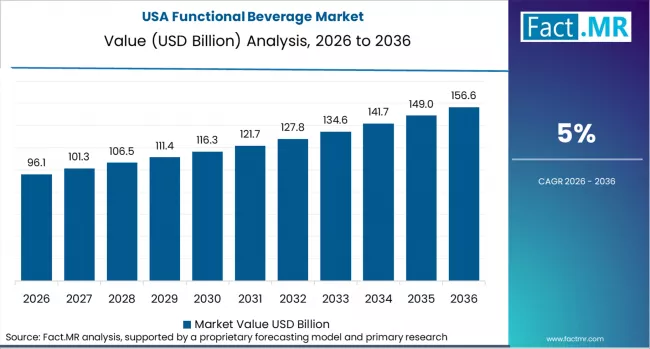
North America is the largest revenue market for functional beverages, led by the United States through premium sports nutrition adoption, established energy drink culture, and the fastest-growing probiotic and adaptogen beverage innovation ecosystem globally. Coca-Cola, PepsiCo, Monster Beverage, and Red Bull dominate market volume, while emerging brands in the functional wellness and nootropic category are capturing disproportionate revenue growth at the premium tier.
- United States: The U.S. functional beverage market is expected to grow at a 5.0% CAGR through 2036. The FDA’s 2024 guidance clarified structure/function health claims for probiotic and prebiotic beverages. This supported wider supermarket distribution of brands such as Olipop and Poppi. Coca-Cola also expanded its Fairlife protein drinks and BODYARMOR sports beverage range in 2025. These launches reflect the consumer shift from traditional soft drinks to health-focused beverages.
FACT.MR’s North American analysis of the functional beverage market covers the United States, Canada, and Mexico. Readers can find FDA health claim regulatory data, sports nutrition market adoption trends, direct-to-consumer functional beverage channel growth benchmarks, and country-level revenue forecasts by product type and ingredient category.
Latin America Functional Beverage Market Analysis
Latin America is a growing functional beverage market driven by Brazil’s expanding fitness culture and rising retail availability of sports and probiotic drinks. Energy drinks lead volume through convenience and hypermarket channels, while premium functional formats are emerging through urban health store and e-commerce distribution as middle-class consumer health awareness rises.
- Brazil: Demand for functional beverages in Brazil is projected to grow at 5.3% CAGR through 2036. ANVISA updated functional beverage health claim regulations in 2024, simplifying product registration. This enabled faster launches of probiotic and vitamin-fortified drinks. Coca-Cola Brazil introduced Del Valle functional juice, while PepsiCo Brasil launched Gatorade H2O electrolyte water in 2025.
FACT.MR’s Latin American analysis of the functional beverage market covers Brazil, Chile, Ecuador, and Rest of Latin America. Readers can find ANVISA health claim registration data, hypermarket and e-commerce channel expansion trends, sports nutrition adoption benchmarks, and country-level revenue forecasts by product type and distribution channel.
Competitive Aligners for Market Players
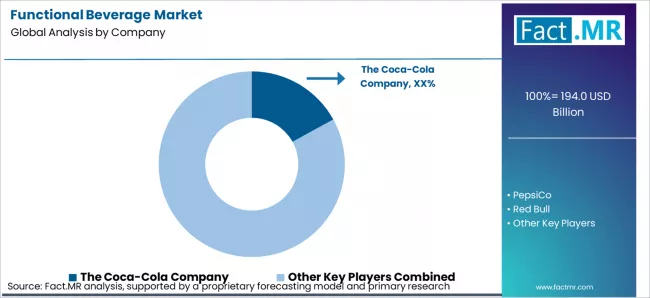
The global functional beverage market shows a mixed competitive structure. Mainstream segments such as energy drinks and sports drinks are moderately concentrated, while premium categories like probiotic, adaptogen, and nootropic beverages are far more fragmented. Major companies including The Coca-Cola Company, PepsiCo, Red Bull, and Monster Beverage Corporation hold significant market share due to their strong brand recognition and extensive retail distribution. However, the rapid emergence of start-ups focused on gut health, cognitive performance, and stress-relief beverages is increasing competition in premium segments.
One of the biggest advantages for large beverage companies is their established bottling and distribution networks. Coca-Cola and PepsiCo benefit from global bottler partnerships that allow them to quickly place new functional beverage products across supermarkets, convenience stores, and foodservice outlets. Red Bull also maintains strong pricing power through its premium positioning and controlled distribution strategy across more than 170 countries.
Retailers play an important role in shaping competition. Supermarkets often stock both branded and private-label functional beverages to manage supplier dependence and negotiate better margins. While private labels can compete in categories like enhanced water or vitamin drinks, strong consumer loyalty toward probiotic brands such as Yakult and Danone Actimel continues to protect pricing power in clinically supported health beverage segments.
Key Players
- The Coca-Cola Company
- PepsiCo
- Red Bull
- Monster Beverage Corporation
- Nestlé S.A.
- Danone
- Dr Pepper Snapple Group
- GlaxoSmithKline
- Keurig Dr Pepper
- Abbott Laboratories
Bibliography
- [1] UK HM Revenue and Customs. (2024). Soft Drinks Industry Levy: 2024 Policy Review Outcome and Rate Maintenance Announcement. July 2024. gov.uk
- [2] Tata Consumer Products Ltd. (2025). Annual Report 2024-25: NourishCo Joint Venture Distribution Expansion and Functional Beverage Retail Outlet Milestone. April 2025. tataconsumer.com
- [3] Monster Beverage Corporation. (2025). Product Launch Release: Monster Energy Probiotic Ultra Functional Energy Drink for U.S. Market. January 2025. monsterbevcorp.com
- [4] Danone SA. (2025). Product Launch Announcement: Activia+ Gut and Immunity Probiotic Drink with Vitamin D3 and Zinc for European Supermarket Distribution. March 2025. danone.com
- [5] PepsiCo Inc. (2024). Product Launch Release: Pepsi Prebiotic Cola with 3g Inulin Prebiotic Fibre for U.S. Supermarket Distribution. September 2024. pepsico.com
- [6] The Coca-Cola Company. (2025). Annual Report 2024: Vitaminwater and Smartwater Category Performance and Enhanced Water Retail Sales Growth Commentary. February 2025. investors.coca-colacompany.com
- [7] Monster Beverage Corporation. (2025). International Expansion Announcement: Asia Pacific Market Entry Programme Through Coca-Cola Bottling Network in India, Vietnam, and Indonesia. February 2025. monsterbevcorp.com
- [8] The Coca-Cola Company. (2024). Product Launch Release: Powerade Ultra Enhanced Sports Drink with Creatine and BCAAs for U.S. and UK Retail Distribution. August 2024. coca-colacompany.com
- [9] SPINS LLC. (2025). Natural Channel Functional Beverage Category Report 2024: Collagen, Adaptogen, and Mushroom Extract Drink Revenue Growth Data. January 2025. spins.com
This Report Addresses
- Strategic intelligence on EU caffeine and sugar regulation reshaping energy drink formulations, India FSSAI functional beverage labelling reform, China SAMR health claim standards, and probiotic clinical evidence driving mainstream consumer adoption globally.
- Market forecast from USD 194 billion in 2026 to USD 328.3 billion by 2036 at 5.4% CAGR, segmented by ingredient type, product type, distribution channel, and region.
- Growth opportunity mapping across India’s e-commerce health beverage expansion, China’s probiotic and TCM-infused innovation, Germany’s clean-label premiumisation, Brazil’s ANVISA health claim reform, and U.S. FDA structure/function claim guidance update.
- Country CAGR outlook for India 7.5%, China 6.8%, Germany 5.7%, Brazil 5.3%, United States 5.0%, and United Kingdom 5.0%, with key regulatory, consumer trend, and channel development drivers per country.
- Competitive analysis of Coca-Cola, PepsiCo, Red Bull, Monster Beverage, Danone, and Nestlé covering product portfolios, distribution network advantages, health claim regulatory positions, and direct-to-consumer channel investment strategies.
- Technology tracking including probiotic strain innovation in beverage formats, adaptogen and nootropic ingredient commercialisation, sugar reduction technologies for mainstream functional drinks, and functional beverage subscription e-commerce platform development.
- Regulatory analysis covering EFSA health claim authorisations, EU energy drink caffeine rules, UK Soft Drinks Industry Levy, FDA structure/function claims guidance, FSSAI functional beverage regulations, China SAMR health food labelling, and Brazil ANVISA functional food registration.
- Report delivered in PDF, Excel datasets, PowerPoint summary, and dashboard formats supported by OEM revenue data, retail category sales statistics, FDA and EFSA filing databases, and primary research interviews.
Scope of Report
| Quantitative Units | USD 194 billion (2026) to USD 328.3 billion (2036), at a CAGR of 5.4% |
|---|---|
| Market Definition | Beverages formulated with bioactive ingredients delivering targeted health, energy, or performance benefits across energy, sports, probiotic, nutraceutical, and enhanced water categories. |
| Ingredient Type Segmentation | Probiotics (35%), Antioxidants, Minerals, Amino Acids, Prebiotics, Vitamins, Super-fruit Extracts, Botanical Flavors |
| Product Type Segmentation | Energy Drinks (42%), Sports Drinks, Nutraceutical Drinks, Dairy-based Beverages, Juices, Enhanced Water |
| Distribution Channel | Supermarkets, Hypermarkets, Health Stores, Online Retail, Departmental Stores, Convenience Stores |
| Application Coverage | Personal health and wellness, sports hydration, gut health and immunity support, cognitive enhancement, and on-the-go energy and hydration. |
| Regions Covered | Asia Pacific, Europe, North America, Latin America, Middle East and Africa |
| Countries Covered | China, Japan, South Korea, India, Australia and New Zealand, ASEAN, Rest of South Asia and Pacific, Germany, UK, France, Italy, Spain, Nordic, BENELUX, Rest of Western Europe, Russia, Poland, Hungary, Balkan and Baltic, USA, Canada, Mexico, Brazil, Chile, Ecuador, Rest of Latin America, Saudi Arabia, GCC, Turkey, South Africa, Rest of MEA |
| Key Companies Profiled | Coca-Cola, PepsiCo, Red Bull, Monster Beverage, Nestlé, Danone, Dr Pepper Snapple, GlaxoSmithKline, Keurig Dr Pepper, Abbott Laboratories |
| Forecast Period | 2026 to 2036 |
| Approach | Hybrid top-down and bottom-up model using retail sales volumes by product type, average selling prices by channel, ingredient cost trends, and primary interviews with brand managers and retail category buyers. |
Functional Beverage Market by Segments
-
By Ingredient Type:
- Antioxidants
- Minerals
- Amino Acids
- Probiotics
- Prebiotics
- Vitamins
- Super-fruit Extracts
- Botanical Flavors
-
By Product Type:
- Energy Drinks
- Sports Drinks
- Nutraceutical Drinks
- Dairy-based Beverages
- Juices
- Enhanced Water
-
By Distribution Channel:
- Supermarkets
- Hypermarkets
- Health Stores
- Online Retail
- Departmental Stores
- Convenience Stores
-
By Region:
- North America
- United States
- Canada
- Mexico
- Latin America
- Brazil
- Chile
- Ecuador
- Rest of Latin America
- Western Europe
- Germany
- United Kingdom
- France
- Italy
- Spain
- Nordic
- BENELUX
- Rest of Western Europe
- Eastern Europe
- Russia
- Poland
- Hungary
- Balkan and Baltic
- Rest of Eastern Europe
- East Asia
- China
- Japan
- South Korea
- South Asia and Pacific
- India
- ASEAN
- Australia and New Zealand
- Rest of South Asia and Pacific
- Middle East and Africa
- Kingdom of Saudi Arabia
- Other GCC Countries
- Turkey
- South Africa
- Other African Union
- Rest of Middle East and Africa
- North America
- Frequently Asked Questions -
How large is the functional beverage market in 2025?
The market was valued at USD 184 billion in 2025.
What will the market size be in 2026?
The market is estimated to reach USD 194 billion in 2026.
What is the projected market size by 2036?
The market is projected to reach USD 328.3 billion by 2036, creating a USD 134.3 billion absolute dollar opportunity over the forecast period.
What is the expected CAGR?
The forecast CAGR from 2026 to 2036 is 5.4%.
Which ingredient type leads the market?
Probiotics hold approximately 35% share in 2026, driven by strong consumer gut health awareness.
Which product type segment dominates?
Energy drinks lead at approximately 42% share in 2026, reflecting their established retail presence.
Which country shows the fastest growth?
India leads at 7.5% CAGR through 2036, driven by rising urban middle-class health awareness.
What is the primary restraint?
EU and UK regulatory pressure on high-caffeine energy drinks and sugar tax levy on mainstream functional beverage formulations are the main structural constraints on conventional energy drink volume growth through 2036.