- Base Value(2025): 82.8 Bn
- Forecast Value (2036): 153.9 Bn
- CAGR (2036): 5.8%
ETO Manufacturing Market Forecast and Outlook By Fact.MR
The ETO manufacturing market was valued at USD 82.8 billion in 2025 and is forecast to reach USD 87.6 billion in 2026 and USD 153.9 billion by 2036, expanding at a CAGR of 5.8%. Industrial Machinery and Equipment leads industry vertical at 30.6% share in 2026. Modular Custom Systems holds the top order type position at 37.2%, with Large Enterprises commanding enterprise type demand at 48.3% in 2026. ETO refers to engineer-to-order manufacturing, where every product is designed around the customer's specific operating environment before fabrication begins. The market's defining economic characteristic is that complexity is unavoidable and margin is only protected when that complexity is managed with discipline. Companies that have cracked the code on industrializing customization, making engineering variation repeatable without making the product generic, are the ones that grow here.
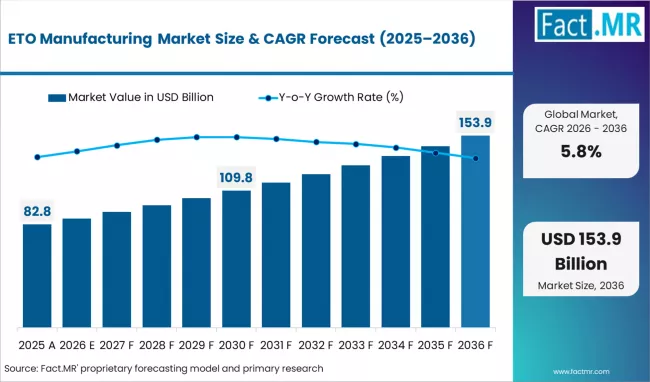
Eto Manufacturing Market Market Value Analysis | Source: Fact.MR
Key Drivers
- Customization Demand: Capital goods buyers increasingly want systems tailored to site, throughput, compliance, and integration constraints.
- Project Complexity: Industrial equipment, process lines, and engineered assemblies require project-based manufacturing logic over repetitive serial production.
- Digital Enablement: CPQ, PLM, project controls, and integrated ERP tools are improving throughput in complex engineer-to-order environments.
Key Segments Analyzed in the Report
- Industry Vertical: Industrial Machinery And Equipment, Energy And Process Systems, Aerospace And Defense, Construction Equipment, Electrical And Automation Systems, And Others
- Order Type: One-Off Project Builds, Modular Custom Systems, Configured Engineered Systems, And Others
- Enterprise Type: Large Enterprises, Mid-Sized Manufacturers, Specialized Job Shops, And Others
- Region: North America, Latin America, Europe, Asia Pacific, And Middle East & Africa
Analyst Opinion
Shambhu Nath Jha, Principal Consultant, Fact.MR says ETO manufacturing grows where customers refuse to buy a standard box. The winners are manufacturers that can industrialize customization without letting engineering rework destroy margin or delivery reliability. The best ETO operators have learned that the answer is not to fight the variation, but to standardize the process of managing it.
ETO Manufacturing Market Definition
The ETO manufacturing market covers revenues generated by engineer-to-order production environments in which products or systems are designed, configured, or significantly engineered to meet customer-specific project requirements before fabrication and delivery.
ETO Manufacturing Market Inclusions
- Revenue from project-driven manufacturing of custom industrial systems, machinery, process equipment, engineered assemblies, and related build-to-spec outputs.
- ETO production environments supported by engineering, project planning, configuration, and tailored fabrication workflows.
- Demand across North America, Latin America, Europe, Asia Pacific, and the Middle East & Africa.
ETO Manufacturing Market Exclusions
- Pure make-to-stock and commodity discrete manufacturing without project engineering intensity.
- Standalone software revenue unless directly embedded in the engineer-to-order production model under study.
- Service-only engineering contracts without associated manufacturing execution or product delivery.
ETO Manufacturing Market Research Methodology
This study evaluates the ETO manufacturing market across industry vertical, order type, enterprise type, and region, using 2025 as the base year and 2026 to 2036 as the forecast period. Market value is expressed in USD billion. Evidence inputs include enterprise workflow documentation, academic and industrial research on engineer-to-order systems, and project-business disclosures from capital-equipment manufacturers and enterprise technology providers. Triangulation aligns project order books, engineering intensity, customization premiums, and enterprise digitalization levels to derive segment and regional estimates.
Key Drivers, Restraints, and Trends in ETO Manufacturing Market
Drivers
ETO manufacturing is growing because many industrial buyers want systems optimized for a precise operating environment over a standard part number. Whether the product is a process skid, a custom production line, or a large engineered assembly, value is created through fit-for-purpose design. That keeps engineer-to-order logic central in capital equipment and specialized industrial production.
Restraints
Complexity is the tax on growth. ETO manufacturers face change orders, long lead times, cost uncertainty, and margin leakage when engineering and production data are not tightly connected. Scale is harder to achieve than in repetitive manufacturing because every order can introduce fresh design, sourcing, and planning risk.
Trends
The market is moving toward modularized customization. Manufacturers are working to preserve engineer-to-order flexibility while standardizing platforms, modules, and digital quotation logic. That allows them to shorten sales cycles, improve costing accuracy, and make high-variance project business more repeatable and commercially attractive.
Segmental Analysis
ETO Manufacturing Market Analysis by Industry Vertical
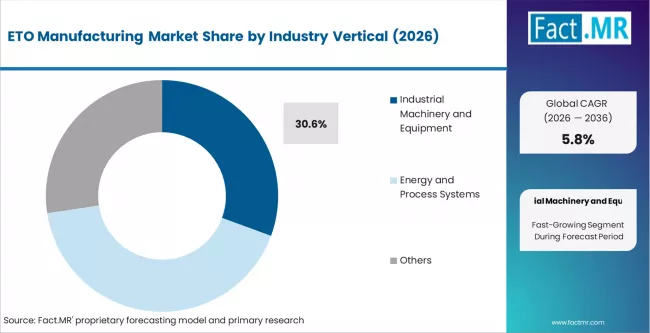
Eto Manufacturing Market Analysis By Industry Vertical | Source: Fact.MR
The Industrial Machinery and Equipment segment is expected to lead the industry vertical category with a 30.6% share in 2026. This segment leads because custom production systems, packaging lines, material-handling equipment, and factory machinery often require detailed engineering around throughput, footprint, and customer process conditions. It is one of the clearest homes for industrialized ETO models.
ETO Manufacturing Market Analysis by Order Type
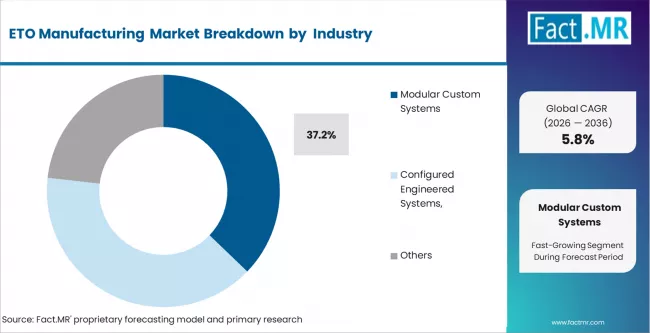
Eto Manufacturing Market Analysis By Order Type | Source: Fact.MR
The Modular Custom Systems segment is expected to lead the order type category with a 37.2% share in 2026. Modular custom systems lead because manufacturers increasingly try to control complexity by reusing engineered modules while still adapting the final system to customer requirements. This is the practical middle ground between one-off engineering and repeatable manufacturing.
Competitive Aligners for Market Players
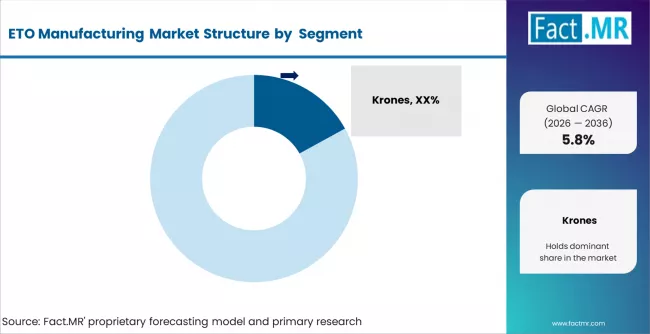
Eto Manufacturing Market Analysis By Company | Source: Fact.MR
The competitive advantage in ETO manufacturing is built on execution infrastructure, not product features. The manufacturers that consistently win large engineer-to-order programs are the ones who have connected their sales quoting, engineering configuration, procurement, and production scheduling into a single controlled workflow where a change in one area propagates correctly through all others. Without that connectivity, every complex order becomes a margin erosion event as change orders pile up and engineering rework bleeds into fabrication time.
Digital tools are reshaping the competitive landscape in a way that favors agile mid-tier manufacturers more than is commonly assumed. CPQ systems that embed engineering rules into the quoting process, PLM platforms that carry design intent through to production, and project management tools calibrated for high-variance build environments are all reducing the organizational complexity tax that previously only large manufacturers could absorb. A well-digitized mid-sized ETO manufacturer can now bid, win, and execute projects that would have been operationally unmanageable a decade ago.
The modular customization trend is the most strategically important shift in this market. Companies like Krones, Alfa Laval, and GEA Group have invested significantly in developing standardized module libraries that can be configured into highly customized systems, giving customers the outcome of engineering-to-order with a fraction of the lead time and cost uncertainty of a pure one-off build. Competitors that have not yet made this investment are finding themselves at a structural disadvantage in competitive bidding, because the modular producers can deliver faster, quote more accurately, and take on more projects simultaneously without scaling their engineering headcount proportionally.
Key Players in ETO Manufacturing Market
- Krones
- GEA Group
- ANDRITZ
- Alfa Laval
- Wärtsilä
- Siemens Energy
- FLSmidth
- SPX FLOW
- John Cockerill
- thyssenkrupp Uhde
Strategic Outlook by Fact.MR on ETO Manufacturing Market
Fact.MR expects ETO manufacturing to remain structurally important wherever project complexity, plant integration, and compliance customization stay high. The strongest growth should come from manufacturers that mix platform discipline with project flexibility and use digital tools to keep engineering variation commercially manageable. In this market, operational excellence is the strategy. There is no shortcut to margin protection that does not run through better workflow control.
Bibliography
- Oracle. 2025. JD Edwards EnterpriseOne Engineer to Order Overview.
- Oracle. 2025. Engineer to Order System Documentation.
- Gosling, J. and Naim, M.M. 2009. Engineer-to-order supply chain management: A literature review and research agenda. International Journal of Production Economics.
- Haddud, A. et al. 2022. An Intelligent Product Service System for Adaptive Maintenance of ETO Manufacturing Equipment. Applied Sciences, 12(5).
- Tacton. 2025. Engineer-to-Order and Smart Configuration Guide.
- SAP. 2025. Engineer-to-Order with SAP S/4HANA.
Scope of the Report

Eto Manufacturing Market Breakdown By Industry Vertical, Order Type, And Region | Source: Fact.MR
| Metric | Value |
|---|---|
| Market Value | USD 82.8 billion in 2025 to USD 153.9 billion by 2036 |
| CAGR | 5.8% from 2026 to 2036 |
| Base Year | 2025 |
| Forecast Period | 2026 to 2036 |
| Industry Vertical Segmentation | Industrial Machinery and Equipment, Energy and Process Systems, Aerospace and Defense, Construction Equipment, Electrical and Automation Systems, Others |
| Order Type Segmentation | One-off Project Builds, Modular Custom Systems, Configured Engineered Systems, Others |
| Enterprise Type Segmentation | Large Enterprises, Mid-sized Manufacturers, Specialized Job Shops, Others |
| Regional Coverage | North America, Latin America, Europe, Asia Pacific, and Middle East & Africa |