- Base Value(2025): 14.1 Bn
- Estimated Value(2026): 16.3 Bn
- Forecast Value (2036): 67.9 Bn
- CAGR (2026 - 2036): 15.3%
Cargo Drones Market Forecast and Outlook By FACT MR
- In 2025, the cargo drones market was valued at USD 14.1 billion. Based on Fact.MR analysis, demand for cargo drones is estimated to grow to USD 16.3 billion in 2026 and USD 67.9 billion by 2036. Fact.MR projects a CAGR of 15.3% during the forecast period.
- The market is projected to add substantial absolute dollar value through 2036, reflecting a transition from demonstration-phase deployments to scaled commercial operations.
- Growth is supported by rising e-commerce fulfillment pressure and expanding regulatory approvals for beyond visual line of sight operations.
- High upfront airframe costs and air traffic management limitations constrain adoption pace in markets without structured drone corridor frameworks.
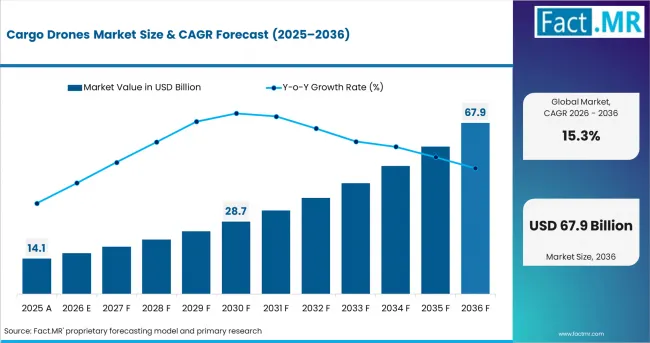
Cargo Drones Market Market Value Analysis | Source: Fact.MR
| Metric | Value |
|---|---|
| Estimated Value in 2026 | USD 16.3 billion |
| Forecast Value in 2036 | USD 67.9 billion |
| Forecast CAGR (2026 to 2036) | 15.3% |
Source: Fact.MR analysis. Updated May 28, 2026
Summary of Cargo Drones Market
- Demand Drivers
- E-commerce fulfillment operators and logistics platform providers are expanding drone delivery programs as same-day and last-mile speed expectations increase across urban and semi-urban markets.
- Healthcare administrators and pharmaceutical distributors are adopting cargo drones for time-sensitive medical supply delivery across remote and underserved geographies where road infrastructure limits conventional transport.
- Defense agencies across the United States, Israel, and India are increasing investment in autonomous cargo drone systems for forward logistics and resupply operations in contested terrain environments.
- Key Segments Analyzed
- By Payload Capacity: Below 50 Kg drones hold 36.9% share in 2026 as lightweight short-range aircraft dominate commercial e-commerce and medical delivery deployments across urban corridors.
- By Range: The 15–30 Km range segment accounts for 34.7% share in 2026 as this corridor covers most last-mile urban delivery routes without requiring extended battery capacity or hybrid propulsion systems.
- By Drone Type: Commercial drones represent 71.2% share in 2026 as logistics operators, e-commerce platforms, and healthcare distributors drive fleet ahead of defense applications.
- By End Use Industry: Logistics holds 24.8% share in 2026 as freight operators integrate cargo drones into hub-to-doorstep delivery networks to reduce ground vehicle dependency.
- By Propulsion Type: Electric powered drones account for 52.6% share in 2026 as battery technology improvements and urban emission regulations accelerate adoption across commercial freight corridors.
- By Geography: China leads at 17.8% CAGR through 2036 as national urban air logistics programs deploy cargo drone fleets across Tier-1 and Tier-2 city freight networks.
- Analyst Opinion at Fact.MR
- Shambhu Nath Jha, Principal Consultant at Fact.MR, opines, ‘CXOs will find that regulatory airspace access and battery range advancement remain the primary factors determining commercial scale timing. Companies securing early route approvals and improving payload-to-range efficiency are strengthening first-mover positions across high-frequency logistics corridors.’
- Strategic Implications
- Cargo drone OEMs should pursue certification strategies for both FAA and EASA type approval simultaneously to reduce time-to-market across North America and European freight corridors.
- Logistics operators expanding into India and China through local drone manufacturer partnerships can access government-subsidized freight corridor licenses that reduce regulatory entry barriers.
- Investing in swappable battery and modular payload bay design reduces aircraft downtime between flights and improves fleet utilization rates across high-frequency urban delivery operations.
China is projected to expand at 17.8% CAGR through 2036 as government-backed urban air logistics programs accelerate fleet deployment across major metropolitan freight corridors. The United States is forecast to grow at 16.9% CAGR driven by FAA Part 135 cargo drone approvals and increasing last-mile delivery contracts from large e-commerce operators. India is expected to record 16.4% CAGR as the Drone Rules 2021 framework opens commercial freight corridors for healthcare and e-commerce applications. Germany is projected to expand at 15.7% CAGR through 2036 as EU drone regulation harmonization supports cross-border freight operations across industrial logistics networks. Japan is forecast to grow at 15.2% CAGR due to rural medical supply delivery programs and aging population logistics needs driving government-subsidized drone freight deployment.
Segmental Analysis
Cargo Drones Market Analysis by Payload Capacity
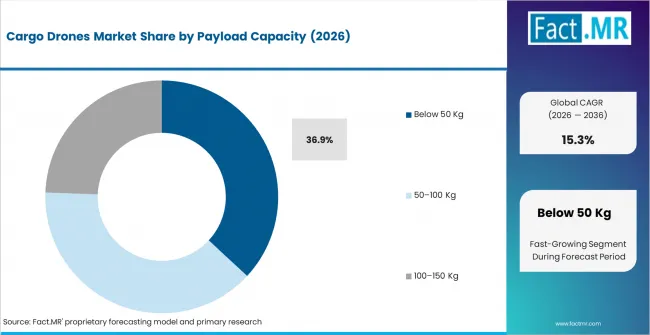
Cargo Drones Market Analysis By Payload Capacity | Source: Fact.MR
Based on Fact. MR’s cargo drones market report, drones with payload capacity below 50 Kg are estimated to account for 36.9% share in 2026. Lightweight cargo drones support parcel delivery and food transport applications without requiring complex heavy-lift engineering systems. Lower operating costs and simplified certification processes are supporting wider deployment.
- Parcel Delivery Expansion: Lightweight cargo drones are increasing deployment across urban parcel and e-commerce delivery operations.
- Medical Supply Transport: Healthcare logistics providers are strengthening adoption of low-payload drones for pharmaceutical and emergency medical delivery.
- Payload Technology Development: Elroy Air completed flight testing of its Chaparral hybrid drone rated for 300-pound payloads during 2024, targeting medium-range defense and commercial logistics routes requiring capacity above standard lightweight platforms. [2]
Cargo Drones Market Analysis by Range
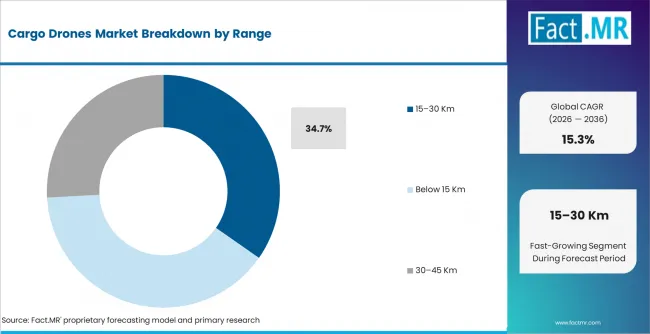
Cargo Drones Market Analysis By Range | Source: Fact.MR
The 15–30 Km range segment is estimated to account for 34.7% share in 2026. This operational range aligns with many urban and suburban delivery routes managed by e-commerce and healthcare logistics operators. Electric propulsion systems are commercially viable across this delivery distance.
- Urban Delivery Optimization: Mid-range cargo drones are improving efficiency across suburban and city-based delivery corridors.
- Healthcare Route Expansion: Medical logistics operators are increasing deployment across regional hospital and clinic delivery networks.
- Short-Range Medical Logistics: Zipline's fixed-wing platform operating within a 15 Km radius delivered over 1 million medical product orders across its African network by mid-2025, demonstrating reliable sub-15 Km medical cargo drone operations at scale. [4]
Cargo Drones Market Analysis by Drone Type
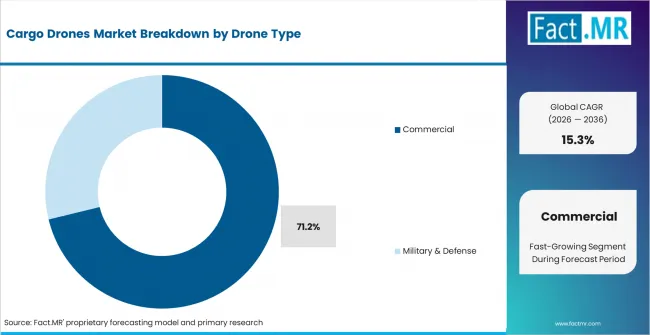
Cargo Drones Market Analysis By Drone Type | Source: Fact.MR
Commercial drones are estimated to contribute 71.2% share in 2026. E-commerce companies and healthcare distributors are expanding deployment through commercial delivery operations. Logistics providers add demand across structured cargo routes.
- Commercial Fleet Scaling: Logistics operators are increasing investment in autonomous delivery fleets across high-frequency cargo routes.
- Defense Logistics Integration: Defense agencies are expanding drone deployment for autonomous resupply and tactical transport missions.
- Dual-Use Platform Expansion: Drone manufacturers are strengthening platforms capable of supporting both commercial and industrial cargo applications.
Cargo Drones Market Analysis by End Use Industry
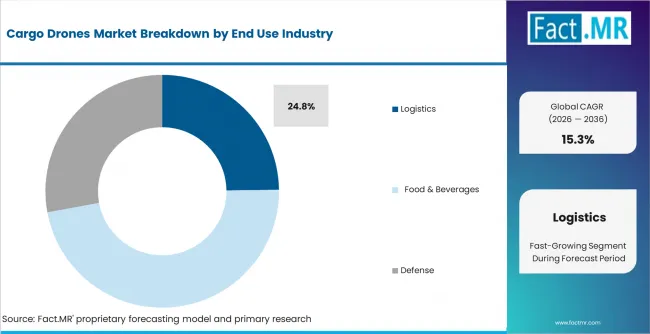
Cargo Drones Market Analysis By End Use Industry | Source: Fact.MR
Based on Fact. MR’s cargo drones market report, logistics accounts for 24.8% share in 2026. Cargo drone integration across hub-and-spoke delivery networks is reducing dependency on ground transportation across congested urban corridors. Rising parcel volume is also supporting higher fleet utilization.
- Urban Delivery Route Coverage: Wing Aviation expanded 15–30 Km drone delivery routes across Logan and Canberra in Australia during 2024 fulfilling pharmacy and retail parcel orders for partnered commercial operators. [3]
- E-Commerce Delivery Expansion: Online retail fulfillment networks are accelerating adoption of autonomous cargo delivery systems.
- Defense Supply Modernization: Defense organizations are strengthening investment in autonomous logistics and remote resupply operations.
Cargo Drones Market Analysis by Propulsion Type
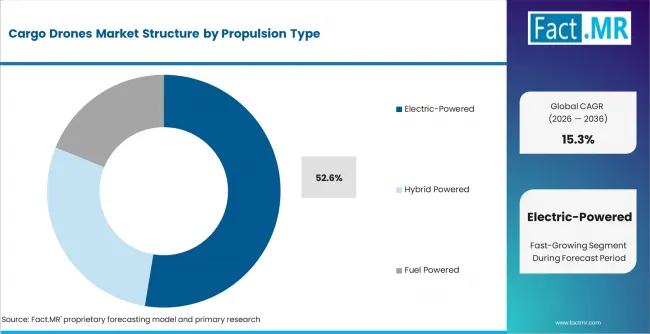
Cargo Drones Market Analysis By Propulsion Type | Source: Fact.MR
Electric-powered drones account for 52.6% share in 2026. Battery improvements and urban zero-emission targets are increasing adoption across commercial delivery corridors. Lower maintenance requirements are supporting electric platform preference among fleet operators.
- Battery Technology Advancement: Improvements in battery density are extending flight endurance across commercial cargo operations.
- Hybrid Propulsion Development: Hybrid systems are gaining adoption for long-range cargo transport beyond standard battery limitations.
- Urban Emission Compliance: Environmental regulations are increasing preference for electric and hybrid cargo drones across urban markets.
Drivers, Restraints, and Opportunities
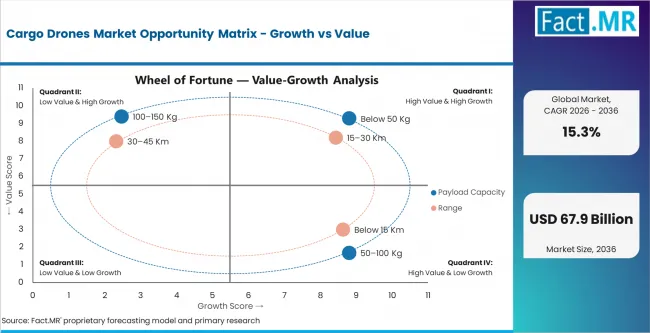
Cargo Drones Market Opportunity Matrix Growth Vs Value | Source: Fact.MR
Fact.MR analysts observe the cargo drones market as an early-commercial sector transitioning from pilot programs to structured logistics deployment. Commercial expansion influenced by regulatory approvals and airspace management frameworks. Logistics operators and defense agencies continue increasing investment in autonomous cargo delivery systems.
- Regulatory Approval Expansion: Expanding BVLOS approvals and commercial airspace frameworks are supporting larger-scale cargo drone deployment across logistics networks.
- Last-Mile Delivery Pressure: Rising urban delivery costs and traffic congestion are increasing demand for autonomous cargo transport alternatives.
Amazon Expands Prime Air Capacity for Faster Drone Deliveries: Amazon announced plans to significantly expand Prime Air drone capacity as part of its accelerated delivery strategy. The company is increasing investment in drone logistics to support ultra-fast e-commerce deliveries within hours and, in some cases, minutes. [1]
Regional Analysis
.webp "Top Country Growth Comparison Cargo Drones Market Cagr (2026 2036)")
Top Country Growth Comparison Cargo Drones Market Cagr (2026 2036) | Source: Fact.MR
The cargo drones market is assessed across North America, Europe, Asia Pacific, Latin America, and Middle East and Africa covering 40+ countries segmented by regulatory framework maturity, commercial freight corridor development, defense activity, and propulsion technology infrastructure. The full report offers market attractiveness analysis by region and country.
| Country | CAGR (2026 to 2036) |
|---|---|
| China | 17.8% |
| United States | 16.9% |
| India | 16.4% |
| Germany | 15.7% |
| Japan | 15.2% |
Source: Fact.MR analysis. Updated May 28, 2026
Source: Fact.MR analysis, based on proprietary forecasting model and primary research
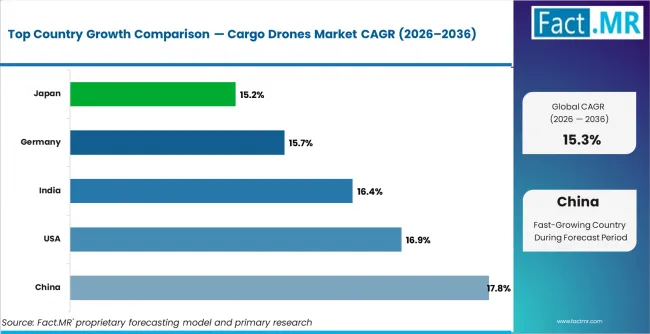
Cargo Drones Market Cagr Analysis By Country | Source: Fact.MR
Asia Pacific Cargo Drones Market Analysis
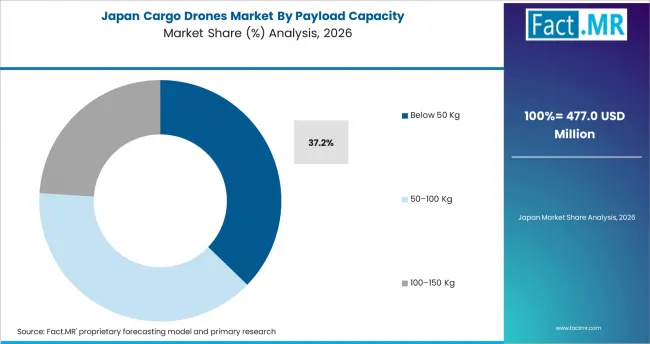
Cargo Drones Market Japan Market Share Analysis By Payload Capacity | Source: Fact.MR
Asia Pacific is one of the fastest-expanding cargo drone markets due to supportive drone regulations and rising investment in logistics automation infrastructure. E-commerce growth and rural delivery demand are accelerating commercial cargo drone deployment across major regional economies.
- China: Demand for cargo drones in China is projected to rise at 17.8% CAGR from 2026 to 2036. Urban air mobility programs and commercial drone approvals are supporting large-scale deployment across e-commerce logistics networks. Government investment in drone service infrastructure and autonomous freight corridors is accelerating cargo fleet expansion across regional delivery routes. JD.com announced plans to build China’s significant low-altitude drone logistics network in partnership with the Shaanxi provincial government. The network will support large-scale e-commerce deliveries and heavy-load cargo transport across remote and urban regions. [5]
- India: Cargo drone demand in India is forecast to expand at 16.4% CAGR by 2036. Regulatory reforms and domestic manufacturing incentives are strengthening commercial cargo drone deployment. Logistics operators are increasing adoption across pharmaceutical delivery and e-commerce freight operations in remote and mountainous regions.
- Japan: The cargo drones market in Japan is projected to grow at 15.2% CAGR through 2036. Autonomous drone delivery approvals and rural logistics modernization programs are supporting wider commercial deployment. Cargo drones are gaining importance across regions with limited road freight accessibility.
Fact.MR's Asia Pacific analysis covers China, India, Japan, ASEAN, South Korea, and Australia and New Zealand. The study includes drone regulation frameworks and commercial freight operator investment trends by country.
North America Cargo Drones Market Analysis
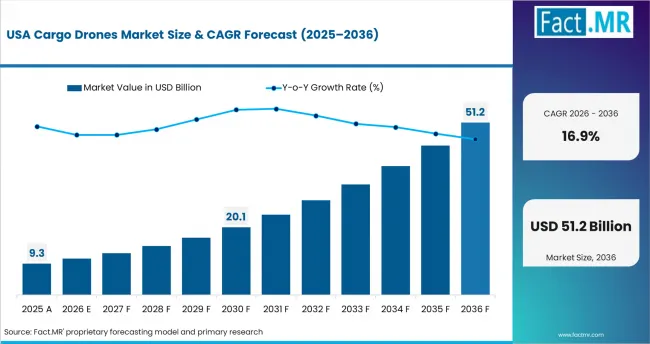
Cargo Drones Market Country Value Analysis | Source: Fact.MR
North America has an advanced regulatory environment for commercial cargo drone deployment due to structured certification frameworks and expanding BVLOS approvals. E-commerce operators and defense agencies driving strong demand for autonomous cargo logistics systems.
- United States: United States is projected to rise at 16.9% CAGR from 2026 to 2036. Commercial airspace approvals are enabling routine cargo drone delivery operations across metropolitan regions. Defense investment in autonomous logistics systems is also increasing deployment across military resupply and emergency transport operations.
Fact.MR's North America analysis covers the United States, Canada, and Mexico. The study includes regulatory impact analysis, defense drone investment trends, and commercial logistics deployment benchmarks.
Europe Cargo Drones Market Analysis
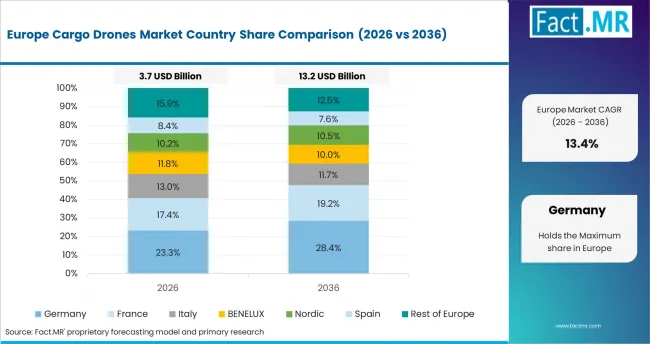
Cargo Drones Market Europe Country Market Share Analysis, 2026 & 2036 | Source: Fact.MR
Europe has harmonized cargo drone rules through structured airspace management frameworks and emission reduction targets for urban freight operations. Logistics operators and postal delivery networks are increasing investment in autonomous cargo transport systems.
- Germany: Cargo drone demand in Germany is projected to expand at 15.7% CAGR by 2036. Commercial drone corridor development and logistics infrastructure investment are supporting cargo drone deployment across industrial regions. Drone manufacturers are expanding production capacity for pharmaceutical and commercial delivery applications.
Fact.MR's Europe analysis covers Germany, the United Kingdom, France, Italy, Spain, Nordic Countries, BENELUX, and Rest of Western Europe. The study includes airspace regulation analysis and autonomous freight deployment trends by country.
Competitive Aligners for Market Players
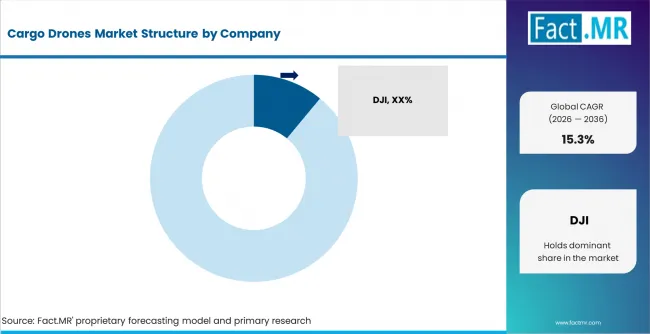
Cargo Drones Market Analysis By Company | Source: Fact.MR
Cargo drone manufacturers are focusing on regulatory approvals, payload efficiency, and route optimization to strengthen commercial positioning. Companies with established BVLOS approvals are gaining faster access to logistics contracts across healthcare, e-commerce, and industrial delivery operations. Regulatory compliance remains a major competitive differentiator across commercial deployment markets. Manufacturers are increasing investment in battery performance and autonomous navigation systems to improve delivery range and operational efficiency. Payload-to-range optimization is becoming a key factor because logistics operators require higher delivery capacity without increasing operating costs. Electric propulsion systems remain the preferred platform for urban delivery networks due to lower maintenance requirements and zero-emission compliance advantages.
Strategic partnerships with logistics providers, healthcare systems, and retail operators are supporting recurring deployment opportunities. Commercial fleet operators are prioritizing high-frequency delivery corridors where cargo drones can reduce transportation delays and improve delivery speed across congested urban routes. Defense agencies are also increasing investment in autonomous cargo transport for remote resupply and tactical logistics applications. This trend is supporting demand for hybrid and long-range cargo drone platforms capable of operating beyond standard electric flight limits.
Asia Pacific is the strongest growth opportunity due to government-backed logistics modernization and expanding drone infrastructure investment. North America continues leading regulatory development and commercial certification standards. Europe is strengthening structured airspace management systems that support scalable autonomous cargo drone deployment across regional logistics networks.
Key Players
- DJI
- AeroVironment, Inc.
- Israel Aerospace Industries (IAI)
- AgEagle Aerial Systems, Inc.
- Elroy Air
- American Robotics
- Microdrones
Bibliography
- [1] Amazon. (2026). Amazon to scale drone delivery operations in 2025. Yahoo Finance.
- [2] Elroy Air. (2025). Elroy Air makes first A to B cargo delivery with its hybrid-electric VTOL aircraft Chaparral.
- [3] Wing. (2025). Wing expands Melbourne drone delivery partnership with DoorDash.
- [4] Zipline. (2025). Zipline expands drone delivery operations across Africa. DroneLife. DroneLife
- [5] JD.com. (2025). JD.com to build largest drone logistics network and R&D campus in China.
This Report Addresses
- Strategic intelligence on cargo drone demand across payload capacity, range, drone type, end use industry, and propulsion type segments covering commercial logistics and defense freight applications globally.
- Market forecast from USD 16.3 billion in 2026 to USD 67.9 billion by 2036 at a CAGR of 15.3% with absolute dollar opportunity assessment across commercial and defense deployment categories.
- Growth opportunity mapping across China urban air logistics program tenders, US FAA BVLOS approval routes, India DGCA commercial cargo drone permits, Germany EASA U-Space corridor licenses, and Japan Ministry of Land rural drone freight subsidies.
- Segment analysis by payload capacity, range, drone type, end use industry, and propulsion type with global and regional CAGR forecasts and leading sub-segment share benchmarks for 2026.
- Regional outlook covering Asia Pacific government-led freight drone program growth, North America FAA certification-driven commercial scaling, Europe EASA U-Space harmonized airspace deployment, and emerging market humanitarian logistics investment.
- Competitive analysis of DJI, AeroVironment, Israel Aerospace Industries, Elroy Air, and Microdrones covering platform certification status, payload-to-range performance, defense contract coverage, and commercial fleet deployment partnerships.
- Regulatory impact analysis covering FAA Part 135 cargo certification requirements, EASA U-Space framework airspace access rules, India Drone Rules 2021 BVLOS approvals, and China CAAC urban air mobility pilot city permits.
- Report delivered in PDF, Excel, and presentation formats supported by drone fleet data, aviation regulatory filing benchmarks, and primary interviews with logistics operations directors and civil aviation authority officials.
Cargo Drones Market Definition
The cargo drones market covers unmanned aerial vehicles designed for autonomous or remotely piloted freight transport across short-to-medium range corridors. These aircraft carry commercial payloads including medical supplies, packaged goods, and industrial components without a pilot onboard.
Cargo Drones Market Inclusions
The study covers global and regional forecasts from 2026 to 2036 across payload capacity, range, drone type, end use industry, and propulsion type. It includes fixed-wing, multirotor, and hybrid cargo drone platforms operating under commercial and defense freight mandates across logistics, healthcare, e-commerce, and construction applications.
Cargo Drones Market Exclusions
The study excludes passenger-carrying urban air mobility aircraft and military surveillance drones not configured for cargo payloads. It omits drone delivery software platforms and ground control systems unless bundled with aircraft contracts. Consumer-grade delivery drones below 1 Kg payload rated for personal use fall outside study scope.
Cargo Drones Market Research Methodology
- Primary Research
- Primary research includes interviews with drone fleet operations managers at logistics companies and healthcare supply chain directors. Government civil aviation authority officials across the United States, China, and India are covered alongside commercial cargo drone OEM teams.
- Desk Research
- Desk research uses public disclosures from DJI, AeroVironment, and Elroy Air. It includes FAA UAS integration program reports, EASA drone regulation updates, and government urban air mobility program disclosures covering 2024 and 2025.
- Market-Sizing and Forecasting
- Market sizing applies a hybrid top-down and bottom-up model. Commercial drone fleet data and freight delivery contract values form the base inputs. Segment forecasts are built separately for commercial and defense applications across payload and range categories.
- Data Validation and Update Cycle
- Data validation uses cargo drone OEM revenue disclosures and logistics operator fleet investment benchmarks validated against 2024 and 2025 company filings. Findings are cross-checked through interviews with aviation regulatory specialists and drone fleet operations directors.
Segmentation
Scope of the Report
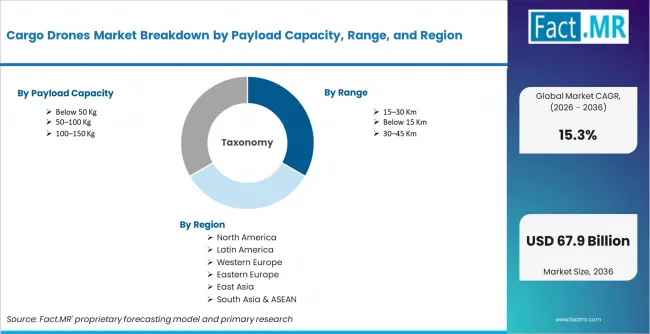
Cargo Drones Market Breakdown By Payload Capacity, Range, And Region | Source: Fact.MR
| Attribute | Details |
|---|---|
| Quantitative Units | USD 16.3 billion (2026) to USD 67.9 billion (2036), at a CAGR of 15.3% |
| Market Definition | Unmanned aerial vehicles designed for autonomous or remotely piloted commercial freight transport across logistics, healthcare, defense, e-commerce, and industrial delivery applications globally. |
| Payload Capacity Segmentation | Below 50 Kg, 50–100 Kg, 100–150 Kg, 150–200 Kg, Above 200 Kg |
| Range Segmentation | Below 15 Km, 15–30 Km, 30–45 Km, Above 45 Km |
| Drone Type Segmentation | Commercial, Military & Defense |
| End Use Industry Segmentation | Logistics, Healthcare & Pharmaceuticals, Food & Beverages, e-Commerce & Retail, Consumer Electronics, Defense, Construction and Mining, Others |
| Propulsion Type Segmentation | Electric Powered, Hybrid Powered, Fuel Powered |
| Regions Covered | North America, Europe, Asia Pacific, Latin America, Middle East and Africa |
| Countries Covered | USA, Canada, Mexico, Germany, UK, France, Italy, Spain, Nordic, BENELUX, China, Japan, South Korea, India, ASEAN, Australia and New Zealand, Brazil, Argentina, Colombia, Saudi Arabia, UAE, South Africa, Rest of MEA |
| Key Companies Profiled | DJI, AeroVironment Inc., Israel Aerospace Industries (IAI), AgEagle Aerial Systems Inc., Elroy Air, American Robotics, Microdrones |
| Forecast Period | 2026 to 2036 |
| Approach | Hybrid top-down and bottom-up model using commercial drone fleet data, defense contract benchmarks, logistics freight corridor analysis, and primary interviews with aviation regulatory officials and logistics operations directors. |
Source: Fact.MR analysis. Updated May 28, 2026
Cargo Drones Market by Segments
-
By Payload Capacity
- Below 50 Kg
- 50–100 Kg
- 100–150 Kg
- 150–200 Kg
- Above 200 Kg
-
By Range
- Below 15 Km
- 15–30 Km
- 30–45 Km
- Above 45 Km
-
By Drone Type
- Commercial
- Military & Defense
-
By End Use Industry
- Logistics
- Healthcare & Pharmaceuticals
- Food & Beverages
- e-Commerce & Retail
- Consumer Electronics
- Defense
- Construction and Mining
- Others
-
By Propulsion Type
- Electric Powered
- Hybrid Powered
- Fuel Powered
-
By Region
- North America
- United States
- Canada
- Mexico
- Latin America
- Brazil
- Argentina
- Colombia
- Rest of Latin America
- Western Europe
- Germany
- United Kingdom
- France
- Italy
- Spain
- Nordic Countries
- BENELUX
- Rest of Western Europe
- Eastern Europe
- Russia
- Poland
- Hungary
- Balkan and Baltic
- Rest of Eastern Europe
- East Asia
- China
- Japan
- South Korea
- South Asia and Pacific
- India
- ASEAN
- Australia and New Zealand
- Rest of South Asia and Pacific
- Middle East and Africa
- Kingdom of Saudi Arabia
- UAE
- South Africa
- Rest of Middle East and Africa
- North America
Frequently Asked Questions
How large is the global cargo drones market in 2025?
What will the cargo drones market size be in 2026?
What is the projected cargo drones market size by 2036?
What is the expected CAGR for the cargo drones market from 2026 to 2036?
Which payload capacity segment is poised to lead the cargo drones market?
Which end use industry holds the leading share in the cargo drones market?
Which country shows the fastest growth in the cargo drones market?
Who worked on this report


Preview the report firsthand - request a free sample
Free SampleGet the brochure for pricing and purchase details
Download PDF