- Base Value(2025): 12.6 Bn
- Forecast Value (2035): 104.8 Bn
- CAGR (2035): 24.1%
Collateral of Adaptive Robotics Market Outlook (2025 to 2035)
The global adaptive robotics market is expected to reach USD 104.8 billion by 2035, up from USD 12.6 billion in 2025. During the forecast period 2025 to 2035, the industry is projected to expand at a CAGR of 23.6%.
The adaptive robotics market is fast-moving as the industries are increasingly concerned about automation, flexibility, and productivity in dynamic manufacturing conditions. As mass customization trends, shorter product life cycles, and the shortage of available labor arise, adaptive robots provide a real-time response, safe cooperation with humans, and the ability to reprogram them easily.
2025-to-2035.webp "Us Adaptive Robotics Market Value(usd Million)2025 To 2035")
Us Adaptive Robotics Market Value(usd Million)2025 To 2035 | Source: Fact.MR
Quick Stats for Adaptive Robotics Market
- Industry Value (2025): USD 12.6 Billion
- Projected Value (2035): USD 104.8 Billion
- Forecast CAGR (2025 to 2035): 23.6%
- Leading Segment (2025): Reconfigurable Robots (37% Market Share)
- Fastest Growing Country (2025-2035): China (24.2% CAGR)
- Top Key Players: ABB, KUKA AG, Fanuc Corporation, Yaskawa Electric Corporation, Universal Robots A/S, Rethink Robotics and Robotiq Inc
These features allow the manufacturers, the logistics sector, and the services industries to improve their operations by optimizing workflows, minimizing downtime, and determining the efficiency of their operations, all within the Industry 4.0 and digital transformation agendas.
What are the drivers of the Adaptive Robotics Market?
Adaptive robotics market is currently on a boom, and it is rapidly transforming to provide more intelligent, flexible and collaborative systems of automation. Increasing product complexity, reducing production time, and worker shortages in manufacturing, logistics, and services areas are leading to the desire to have robots capable of adaptation in the real-time environment to changing environments and tasks. Adaptive robots allow the safe interaction of humans and robots, fast reprogramming and mix in the established workflow.
Workplace safety regulatory pressures, coupled with Industry 4.0 make adoption even faster. These systems paired with AI, sensors, and machine vision make productivity, minimize downtimes and can serve as one of the foundations of agile and data-driven operations in the future.
What are the regional trends of the Adaptive Robotics Market?
The adaptive robotics market growth is regional and indicates fluctuating maturity of automation, industrial digitalization, and workforce characteristics. High labor costs and investment in Industry 4.0 are favorable to North American countries that are very active in advanced manufacturing, logistics automation, and AI-driven robotics.
Closely behind is Europe, dominated by precision engineering, collaborative robotics in the automotive and electronic industries and the comprehensive set of workplace safety regulations, where Germany and France lead.
The fastest growth is in Asia-Pacific due to massive production in large-scale manufacturing, government-funded smart factories projects, and the quick adoption of robotics in China, Japan, and South Korea. In the meantime, adaptive robotics is also slowly finding its way to Latin America and the Middle East in order to increase productivity and solve labor shortages.
What are the challenges and restraining factors of the Adaptive Robotics Market?
One of the fundamental issues of the adaptive robotics market is the integration of robots in the different production environments, with different levels of automation infrastructure, vendors, heterogeneous legacy systems and processes, and safety conditions. The absence of an agreed interoperability mechanism and the complex customization requirement also make it hard to seamlessly roll out the technology especially in the SMEs.
The risks of cybersecurity posed by the connected, AI-enabled robots suggest the need to have strong encryption and adherence. In developing economies where technical know-how is lacking, connectivity is sporadic and outdated equipment retards the change. Major investment costs are high, maintenance costs and training costs are a deterrent to the investment. Furthermore, emerging laws concerning safety at workplace, relationship between human and robots, and data management contribute to the complexity in implementation with respect to global manufacturing and service industries.
Country-Wise Insights
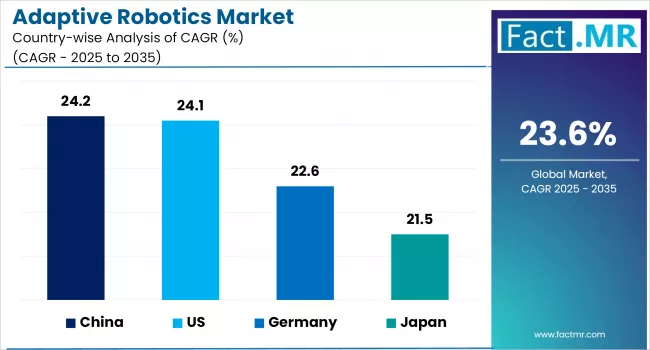
Adaptive Robotics Market Cagr By Country | Source: Fact.MR
United States leads adaptive robotics adoption through innovation and automation
The U.S. adaptive robotics market is sustained by extensive adoption in high-tech manufacturing, logistics, and care made possible by Industry 4.0 and the high-wage economy. Demands and shorter product cycles require the need to meet mass customization, and so does the demand for more flexible programming and easy collaboration between man and AI-powered robots, which is prioritized by American companies. High levels of investment in R&D by both large technology firms and research universities increase the speed of innovation, and good venture capital investment helps startups.
2025-to-2035.webp "Us Adaptive Robotics Country Value(usd Million)2025 To 2035")
Us Adaptive Robotics Country Value(usd Million)2025 To 2035 | Source: Fact.MR
Automotive, electronics, and warehouse automation are the industries that can be noted to lead in the adoption of the latter. Clarity in regulations regarding safety standards and interoperability would encourage the deployment, whereas retraining of the workforce with the involvement of the government would be used to fill in the appropriate skills gaps, which would ensure the devices would be able to be deployed with the scalable integration in both industrial and service spectrums.
China dominates adaptive robotics with manufacturing scale and policy support
China is at the forefront in the adoption and use of adaptive robotics in its mass manufacturing and government encouragement in the form of initiatives such as the Made in China 2025 program. High growth rates of automotive, electronics, and e-commerce logistics create the need to have robots that are able to work in adjustable production lines.
There is the monopolization of local manufacturers, providing economical solutions with a combination of AI and machine vision, which allows the country to dominate at the local level and increase exports. Adoption is being spurred by significant investment from large investors in smart factories and the industrial Internet of Things, especially in coastal manufacturing centers.
There are regional pilot projects on autonomous warehouses and flexible assembly lines that are establishing new standards of real-time, adaptive automation. Supportive policies, talent development, and the maturity of the supply chain support the leadership of China.
Japan leads adaptive robotics with precision, innovation, and smart manufacturing
Japan's Adaptive Robotics Market has the advantage of global superiority in precision manufacturing, the engineering of robotics and the culture of automation. Automated assembly of automobiles, manufacture of semiconductors, and medical equipment manufacturing are just some of the examples of high use, because the ability to have precision and adaptability are extremely important.
The close cooperation of the government, industry, and academic organisations contributes to the rapid growth of safe, people-friendly collaborative robots. The pressure of an aging workforce is also contributing to adoption (in sectors that rely on service, such as elderly care and logistics).
Japan robotics companies like FANUC, Kawasaki, and Yaskawa combine the adaptive control system with smart sensors to satisfy the high-level tasks. Through its record of government-supported advances under the umbrella of “Society 5.0”, it is ensured that innovation, standardization, and integration into smart manufacturing ecosystems continue to propagate.
Category-Wise Analysis
AI-driven adaptive robotics enhance efficiency, accuracy, and operational scalability
The material handling & packaging sector is being adopted even faster due to the application of adaptive robotics which can increase throughput, precision and versatility in high mix high volume facilities. Safe interaction with variable geometries of products is possible utilizing AI-driven sensing and motion planning, which helps to reduce changeover downtime. End-effectors are lightweight with reconfigurable platforms providing flexibility to a variety of SKUs and integrated vision systems improve pick-and-place accuracy.
The segment is associated with e-commerce growth and employing high reliability and low error levels is necessary due to the need of rapid order fulfillment. Actuation aimed at energy optimization and modular control design can support optimization of operational costs, whereas predictive maintenance potential can help to avoid inefficiencies in terms of unplanned stoppages of the operations in order to create fully automated and scalable operations in terms of fulfillment.
AI-powered robots deliver complete independence in complex operational environments
The independence of fully autonomous adaptive robots is becoming a common theme and is being enabled by AI and machine learning. They also use complex sequences and have highly developed perception, decision-making and actuation systems, returning to unstructured environments without the intervention of humans. The productivity of this independence is increased in 24/7 industries like warehousing, healthcare logistics and precision agriculture.
The use of integrated edge computing will lower the latency of the decision loop, whereas adaptive algorithms will allow optimizing routes and reprioritization of tasks in real-time. They have self-diagnostic and predictive maintenance functionality, which enhances uptime, and the ability to run on IoT ecosystems makes them easily integrate into a smart factory network. Their long-term growth trend is also reinforced by increasing labor shortage and the sustainability requirement.
Competitive Analysis
Key players in the Adaptive Robotics Market include ABB, KUKA AG, Fanuc Corporation, Yaskawa Electric Corporation, Universal Robots A/S, Rethink Robotics and Robotiq Inc.
Competition is rising in the market of adaptive robotics as the firms attempt to add AI, machine learning, and advanced sensors to next-level systems. Modularity, human-to-robot cooperation and fast reconfigurability are gaining more and more focus by industry players that need to hook up to different industrial and service requirements. Alliances between robotics companies, automation integrators, and AI software developers are speeding up the rate of innovation. New entrants are arising in specialty segments such as adaptive healthcare robotics, autonomous logistics, and reconfigurable assembly systems. The international pressure of competition is also supported by regional production centers and the government incentives involved, which shift businesses toward affordable production, quicker implementations, and environmentally-friendly robotics.
Recent Development
- In June 2025, Doosan announced its new AI Robot Solution, where smart robotic technologies will be provided to various industries to help them improve automation.
- In April 2025, UR and MiR showcased AI-powered automation solutions, including the OptiMove motion control algorithm. This technology maximizes the aspect of speed and acceleration, which can enable cobot-assisted processes of soldering an electronic product.
Fact.MR has provided detailed information about the price points of key manufacturers of Adaptive Robotics Market positioned across regions, sales growth, production capacity, and speculative technological expansion, in the recently published report.
Methodology and Industry Tracking Approach
The Global Adaptive Robotics Market analysis report of 2025 was based on a survey of 10,000 stakeholders including 30 nations each with a minimum of 300 respondents per location. The end users or adopters (e.g., manufacturing plants, logistics operators, healthcare facilities) comprised over 65 % of the participants with the rest being industry experts, system integrators, and technology providers. Adoption trends, operational challenges, investment patterns, and technology gaps were some of the data items collected in the period July 2024- June 2025. Some of the secondary sources used in the study include patents, technical white papers, regulatory filings, and financial reports within the industry, among others and are more than 250 in number. Cluster analysis and multivariate regression were used as professional statistical methods to produce convincing, data-based information.
With Fact.MR monitoring consumer behavior, product efficacy, industry trends, and market opportunities since 2018, this report is becoming an authoritative source of information that stakeholders can rely on.
Segmentation of Adaptive Robotics Market
-
By Type :
- Flying Robots
- Soft Robots
- Reconfigurable Robots
-
By Payload Capacity :
- Up to 5 kg
- 5-15 kg
- 15-30 kg
- Above 30 kg
-
By Application :
- Industrial
- Assembly & Disassembly
- Material Handling & Packaging
- Welding & Soldering
- Painting & Coating
- Quality Inspection
- Machine Tending
- Non-Industrial
- Healthcare & Rehabilitation
- Retail & Hospitality
- Agriculture
- Logistics & Warehousing
- Defense & Security
-
By Level of Autonomy :
- Semi-Autonomous
- Fully Autonomous
-
By Region :
- North America
- Latin America
- Western Europe
- Eastern Europe
- East Asia
- South Asia & Pacific
- Middle East & Africa